



What's Happening?
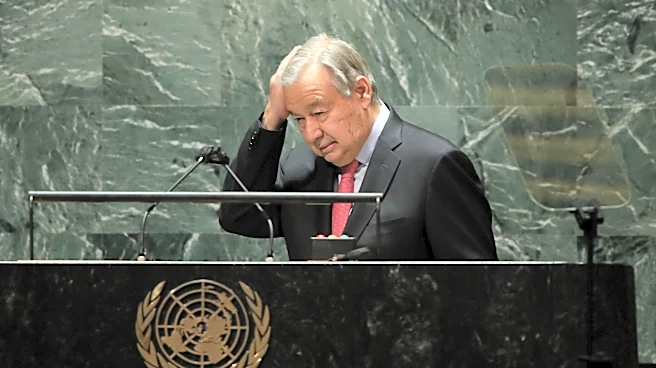
United Nations Secretary-General Antonio Guterres has reiterated the critical importance of upholding the sovereignty, territorial integrity, and political independence of all nations without applying double standards. In a statement posted on his X account
on Saturday, November 7, Guterres highlighted that the UN Charter has been instrumental in preventing a third world war over the past 80 years. He stressed that the Charter establishes a common rule for all countries, mandating respect for each nation's sovereignty, territorial integrity, and political independence. Guterres asserted that this principle must be applied universally, with no exceptions or differential treatment for any country. He further defined true peace as the rule of law prevailing over power, implying that power must always be exercised within legal frameworks.
Why It's Important?
Secretary-General Guterres's statement is a significant reaffirmation of foundational international law and the principles underpinning global stability. In an era marked by geopolitical tensions and conflicts, his emphasis on non-negotiable respect for sovereignty and territorial integrity serves as a crucial reminder to member states. The call to avoid double standards directly addresses concerns about perceived inconsistencies in how international law is applied, which can erode trust in global institutions and exacerbate conflicts. For the U.S., adherence to these principles is vital for its foreign policy, as it often champions the international rules-based order. Any deviation or perceived hypocrisy can undermine its diplomatic influence and complicate efforts to address global challenges, from regional disputes to humanitarian crises. Upholding these tenets is essential for maintaining predictable international relations and preventing wider conflicts.
What's Next?
Guterres's statement serves as a renewed call to action for UN member states to recommit to the core tenets of the UN Charter. While it does not outline specific immediate actions, it sets a clear moral and legal framework for future international engagements and resolutions. Member states, including the U.S., will likely continue to navigate complex geopolitical landscapes where these principles are frequently tested. The UN will continue to advocate for diplomatic solutions and adherence to international law in ongoing conflicts and disputes. Future UN Security Council debates, General Assembly resolutions, and diplomatic efforts will likely reference these foundational principles as the international community grapples with challenges to national sovereignty and territorial integrity. The statement reinforces the UN's role as a guardian of international norms and a platform for dialogue on global peace and security.
Beyond the Headlines
The Secretary-General's remarks delve into the philosophical underpinnings of international relations, highlighting the tension between power and law. His assertion that true peace is the rule of law over power underscores a fundamental challenge in global governance: ensuring that powerful nations operate within established legal boundaries rather than asserting dominance through force. This has profound implications for the future of multilateralism and the effectiveness of international institutions. If the principle of universal sovereignty is selectively applied, it risks creating a fragmented world order where might makes right, leading to increased instability and conflict. Guterres's message is a plea for a more equitable and predictable international system, one where all nations, regardless of their power, are afforded the same respect under international law. This vision is critical for fostering long-term global cooperation on shared challenges like climate change, pandemics, and economic stability.