







What's Happening?
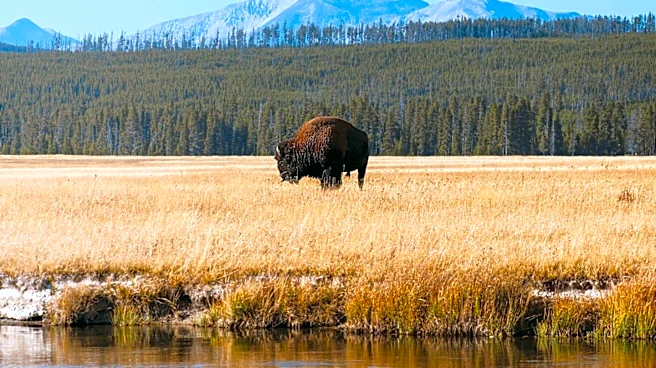
Yellowstone National Park photographers have been tracking the fates of several 'celebrity' bison, including 'Spinny,' 'Tiny Tim,' and the bull that injured Carl McDaniel. 'Tiny Tim,' a bison with an injured leg, is presumed dead after disappearing in September,
with a carcass found in the area. 'Spinny,' a bison exhibiting unusual spinning behavior, has survived and appears to be improving, though still showing signs of impairment. The bison that injured 65-year-old Carl McDaniel at Bridge Bay Campground in July was not subjected to management action by park officials and remains in the park. These updates come as the summer season concludes, prompting public interest in the animals' well-being.
Why It's Important?
This situation underscores Yellowstone National Park's long-standing policy of non-intervention in natural processes, even when it involves injured or struggling wildlife. The public's emotional investment in these 'celebrity' bison highlights a common tension between human empathy for individual animals and the ecological principle of allowing nature to take its course. This policy is crucial for maintaining the integrity of the park's ecosystem, where natural selection and predator-prey dynamics play vital roles. While some may advocate for intervention, park officials and wildlife photographers emphasize that interfering with these processes could set a precedent that undermines the wild character of Yellowstone. The outcomes for these bison serve as a real-world illustration of the harsh realities of wildlife survival in an untamed environment.
What's Next?
The coming winter will be a critical test for 'Spinny,' who still exhibits some impairment. His ability to find sufficient forage and withstand harsh weather conditions will determine his survival. For the bison that injured Carl McDaniel, its continued presence in the park without intervention reinforces the park's commitment to its natural management philosophy. The public will likely continue to follow updates from wildlife photographers, who serve as key communicators of these animals' stories. The ongoing discussions surrounding these bison will likely continue to shape public understanding and debate regarding wildlife management practices in national parks.
Beyond the Headlines
The stories of these bison delve into deeper ethical and philosophical questions about humanity's role in nature. The desire to intervene and 'save' individual animals, particularly those with compelling narratives, reflects a human tendency to anthropomorphize wildlife. However, the park's non-intervention policy champions a more hands-off approach, prioritizing the health of the ecosystem over the fate of any single animal. This approach, while sometimes difficult for the public to accept, is fundamental to preserving the wildness and ecological balance of places like Yellowstone. It challenges visitors to confront the raw, often brutal, realities of nature and to appreciate the complex interplay of life and death that defines a truly wild landscape.