
What's Happening?
Astronomers have discovered a massive cloud with metallic winds orbiting a mystery object, which has caused a star to dim significantly for nearly nine months. This discovery was made using the Gemini
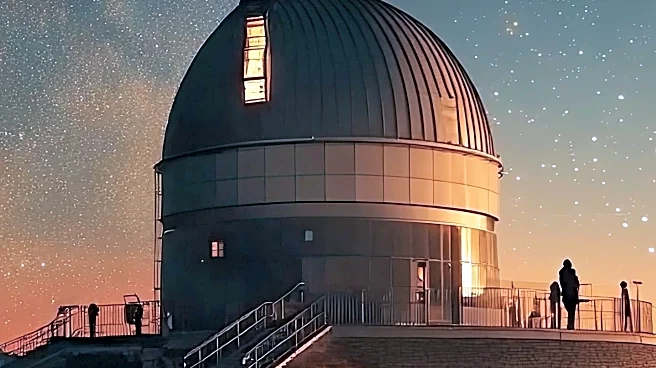
South telescope in Chile, part of the International Gemini Observatory. The star, J0705+0612, located 3,000 light-years away, experienced a dramatic decrease in brightness, prompting further investigation by a team led by Nadia Zakamska, a professor of astrophysics at Johns Hopkins University. The team determined that the star was obscured by a vast cloud of gas and dust, estimated to be about two billion kilometers from the star and 200 million kilometers in diameter. The cloud is gravitationally bound to a secondary object, possibly a planet, brown dwarf, or low-mass star, which orbits the star in its outer planetary system.
Why It's Important?
This discovery provides a rare opportunity to study the dynamic processes shaping planetary systems long after their formation. The ability to measure the internal gas motions of a disk orbiting a secondary object is unprecedented and offers new insights into the evolution of planetary systems. The presence of metals like iron and calcium in the cloud suggests complex chemical processes at play. Understanding these processes can help scientists learn more about the formation and evolution of planetary systems, including our own. The findings also highlight the capabilities of modern astronomical instruments like the Gemini High-resolution Optical Spectrograph (GHOST), which can rapidly respond to transient astronomical events.
What's Next?
Further observations and analyses are likely to continue as astronomers seek to understand the nature of the secondary object and the origins of the massive cloud. Theories suggest the cloud may have formed from a collision between planets, ejecting debris into space. Continued study of this system could provide valuable insights into the long-term evolution of planetary systems and the potential for similar events in other star systems. The findings may also prompt the development of new observational techniques and technologies to study similar phenomena in the universe.
Beyond the Headlines
The discovery underscores the dynamic and ever-changing nature of the universe, challenging the notion of static celestial systems. It also raises questions about the potential for similar large-scale collisions in other mature planetary systems, which could have implications for our understanding of planetary formation and destruction. The study of such events can also inform models of planetary system evolution and the potential for life in other parts of the universe.