






What's Happening?
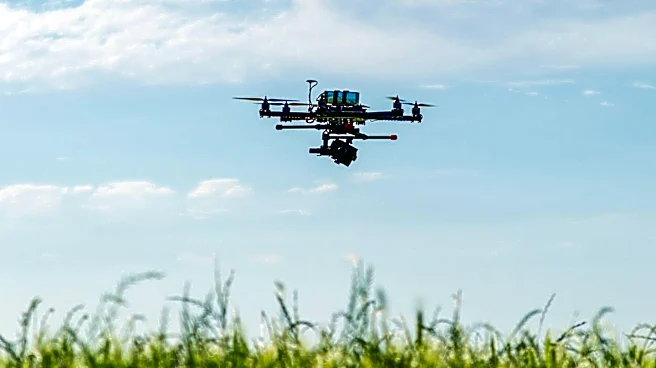
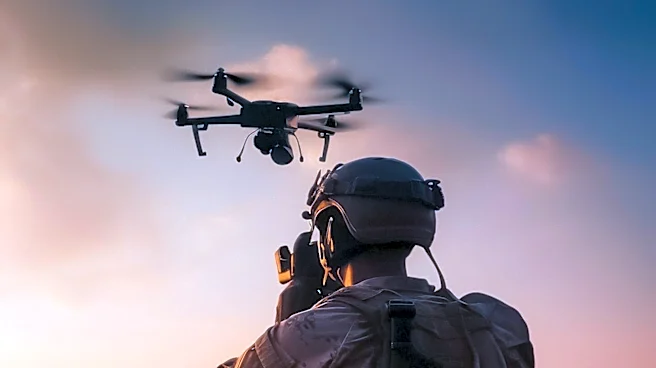
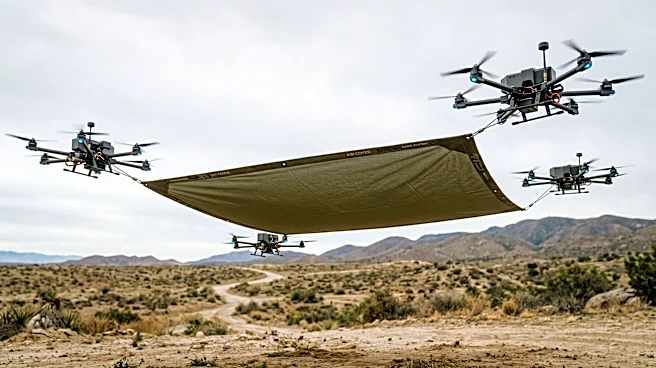
Vigil Autonomy, an Austin-based company, has unveiled 'Air Cover,' an autonomous camouflage system designed to conceal military vehicles, equipment, and personnel. This innovative system utilizes aerial lift units, specifically four drones, to position
a large membrane above targets. The company claims its software can reposition the canopy relative to the protected asset and even move it to create decoys. Air Cover is offered in three sizes: a 2x2-meter version for personnel, a 3x3-meter version for small units, and a 10x10-meter system for vehicles and equipment. Vigil Autonomy states the system provides infrared and radar signature management. The system is designed for persistent deployed concealment with optional active lift, suggesting it can also operate in a stationary configuration secured to supports. The flight endurance targets are listed as four hours for the smallest configuration, three hours for the middle version, and two hours for the largest, with a maximum operating altitude of ten meters. The company has not yet published independent measurements of its effectiveness against sensors, deployment times, or pricing.
Why It's Important?
The introduction of Air Cover represents a significant development in military camouflage technology, potentially offering enhanced protection against modern surveillance threats. Traditional camouflage nets are often cumbersome and time-consuming to deploy, leaving personnel exposed. An automated, drone-supported system could drastically reduce deployment times and personnel exposure, particularly in high-threat environments where reconnaissance drones and precision strikes are prevalent. The ability to reposition the canopy and create decoys could force adversaries to expend valuable resources on false targets, thereby increasing the survivability of actual assets. If proven effective, this technology could influence tactical operations, logistics, and force protection strategies, especially in conflicts characterized by pervasive aerial surveillance. However, the system's practical utility will depend on its performance in real-world conditions, including wind tolerance, operational endurance, and resistance to electronic warfare.
What's Next?
For Air Cover to gain widespread adoption, Vigil Autonomy will need to provide independent validation of its performance metrics, including effectiveness against infrared and radar sensors, deployment and recovery times, and operational endurance in various environmental conditions. Demonstrations in challenging battlefield environments, such as Ukraine, could provide crucial real-world feedback and build confidence in the system's capabilities. Potential next steps include military evaluations and procurement contracts, which would signify a significant step towards operational deployment. The company will also need to address practical concerns such as maintenance requirements for the drone components, battery life, and the system's resilience to wind and potential drone failures. Comparative testing against established camouflage systems, like Saab's Barracuda, would also be essential to highlight its unique advantages.
Beyond the Headlines
The development of drone-supported camouflage systems like Air Cover points to a broader trend in military technology: the integration of autonomous systems to enhance traditional battlefield capabilities. This innovation could lead to a paradigm shift in how concealment and deception are executed, moving from static, labor-intensive methods to dynamic, automated solutions. Ethically, such systems raise questions about the increasing automation of warfare and the potential for reduced human involvement in tactical decisions. Legally, the deployment of drone-based systems often involves complex regulatory frameworks regarding airspace use and potential interference with other aerial assets. Culturally, the image of a 'flying tarp' might initially seem unconventional, but its potential to save lives and protect critical assets could quickly normalize its presence on the battlefield, further blurring the lines between traditional military equipment and advanced robotics. This technology could also spur further innovation in drone applications for logistics, reconnaissance, and electronic warfare.