



What's Happening?
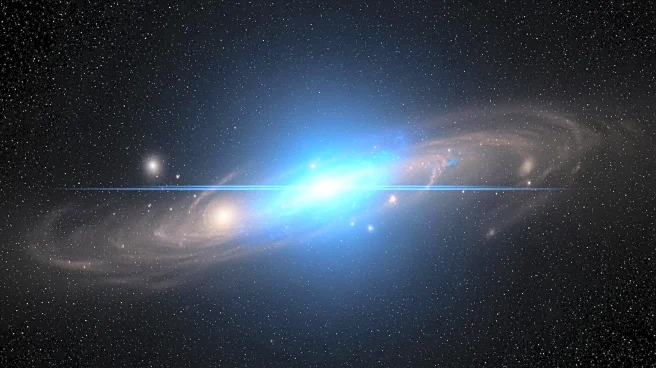
Astronomers have been observing a rare and mysterious phenomenon known as luminous fast blue optical transients (LFBOTs), characterized by startlingly bright, electric blue flashes in the night sky. These events, which blaze for days before fading, have defied
easy categorization. A recent study by a team at UC Berkeley suggests that these flashes are caused by an extreme tidal disruption event, where a massive black hole, up to 100 times the mass of the Sun, tears apart a massive stellar companion. The most recent and brightest event, cataloged as AT 2024wpp, has provided new insights into these cosmic occurrences.
Why It's Important?
The study of LFBOTs is crucial for understanding the dynamics of black holes and their interactions with nearby stars. These events offer a unique opportunity to observe the processes involved in the destruction of a star by a black hole, providing insights into the physics of accretion and jet formation. The findings could also help refine models of black hole formation and growth, contributing to our broader understanding of the universe. Additionally, LFBOTs serve as a testbed for studying extreme astrophysical phenomena, offering a glimpse into the violent and energetic processes that occur in the cosmos.
What's Next?
Astronomers plan to continue monitoring LFBOTs to gather more data and refine their understanding of these events. The development of dedicated ultraviolet observatories, such as ULTRASAT and UVEX, will enhance the ability to detect and study these phenomena. By capturing LFBOTs early, researchers hope to map their environments and better understand the progenitor systems involved. This ongoing research will contribute to the field of astrophysics by providing new insights into the behavior of black holes and their interactions with massive stars.