



What's Happening?
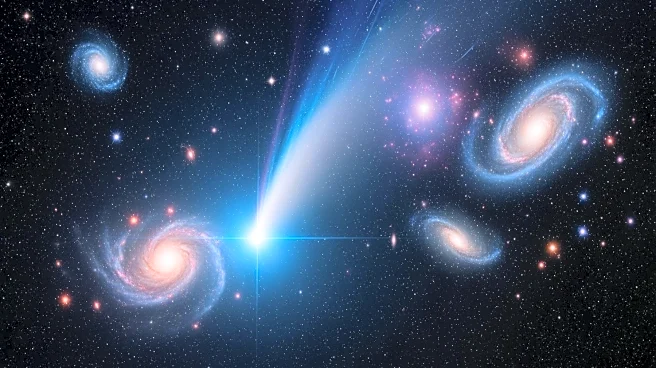
The year 2025 has been marked by the appearance of three significant comets: 3I/ATLAS, C/2025 A6 (Lemmon), and C/2025 R2 (SWAN). Comet 3I/ATLAS, discovered by the ATLAS telescope, is the third interstellar visitor to our solar system, drawing scientific
and public interest. Comet Lemmon became a favorite among astrophotographers due to its dynamic tail, while Comet SWAN provided a stunning visual as it passed in front of the Eagle Nebula. These comets have offered unique opportunities for observation and study, with 3I/ATLAS being the brightest interstellar object discovered to date.
Why It's Important?
The appearance of these comets has provided valuable insights into the nature of interstellar objects and their interactions with the solar system. Comet 3I/ATLAS's brightness and size have sparked interest in understanding interstellar phenomena, while Comet Lemmon's photogenic qualities have engaged the astrophotography community. These events highlight the importance of continued observation and study of celestial bodies, contributing to the broader understanding of the universe and potentially influencing future space exploration missions.
What's Next?
Astronomers will continue to monitor these comets, particularly 3I/ATLAS, to gather more data on its composition and behavior. The scientific community may focus on analyzing the chemical makeup of these comets to better understand their origins and potential impact on the solar system. Future observations could lead to new discoveries about interstellar travel and the formation of celestial bodies.
Beyond the Headlines
The fascination with these comets extends beyond scientific inquiry, capturing the imagination of the public and sparking discussions about the possibility of extraterrestrial life. The dramatic breakup of Comet K1 ATLAS adds to the narrative of cosmic unpredictability, emphasizing the dynamic nature of space phenomena. These events serve as a reminder of the vastness and complexity of the universe.