





What's Happening?
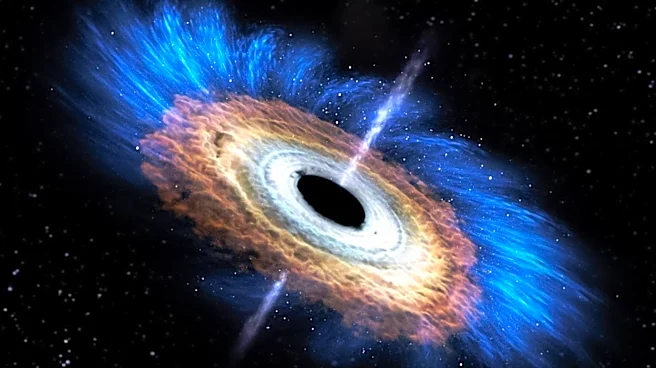
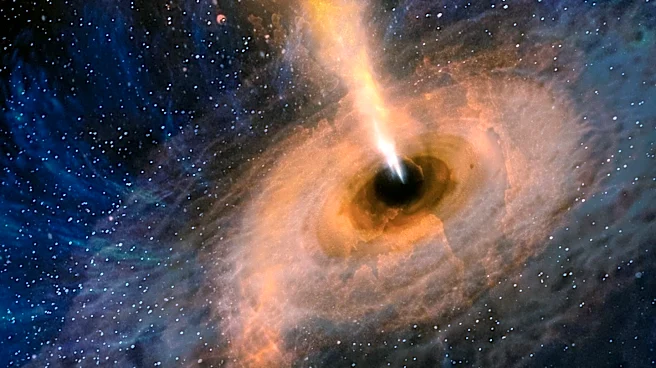
An international team of astronomers, co-led by Andrew Mummery of the Institute for Advanced Study and Adelle Goodwin of Curtin University, has identified a universal rule that dictates the production of powerful jets from black holes. This rule applies
to black holes of all sizes, from stellar-mass black holes (approximately ten times the mass of our sun) to supermassive black holes (millions of times heavier). The research, published in Nature Astronomy, focused on tidal disruption events (TDEs), where a star passes too close to a supermassive black hole and is torn apart by intense gravitational forces. These events provide a unique opportunity to observe black hole behavior after a sudden influx of stellar material. The study combined years of observations from telescopes across multiple wavelengths, including optical, ultraviolet, X-ray, and radio waves, from various locations globally and in space. The team analyzed ten high-quality TDEs to determine the black hole's feeding rate and the timing of its radio outflows.
Why It's Important?
This discovery is significant because it suggests that the fundamental physics governing black hole behavior is consistent across an enormous range of masses, a concept long suspected but difficult to confirm due to the vast timescales involved in supermassive black hole evolution. Tidal disruption events offer a faster way to study these processes, as the feeding episodes around supermassive black holes can unfold over just a few years. The identification of two distinct periods for jet formation—one early, during extremely high feeding rates, and another much later, when the feeding rate drops to about two percent of the Eddington limit—provides crucial insights. This two percent threshold is particularly important as it is already known to trigger jet formation in smaller black holes within our galaxy, reinforcing the universality of this mechanism. This understanding could lead to a more unified theory of black hole physics.
What's Next?
The ability to predict when a black hole is likely to produce a delayed jet has practical implications for astronomers. This knowledge will allow researchers to schedule observations more efficiently, increasing the chances of capturing these short-lived events as they occur. This improved efficiency will be particularly valuable for heavily requested telescopes and will reduce the number of observations made when little activity is expected. The findings are expected to be especially useful for major future observatories, such as the Square Kilometre Array radio telescope project, which is anticipated to begin collecting scientific data in 2028. By understanding the critical accretion rates for jet formation, astronomers can optimize their observational strategies and potentially make more profound discoveries about the universe.
Beyond the Headlines
The finding that black holes of all sizes adhere to the same rule for jet formation hints at a deeper, underlying simplicity in the complex physics of the universe. It suggests that despite their immense differences in scale and environment, the fundamental processes governing these cosmic behemoths are remarkably similar. This universality could have profound implications for our understanding of galaxy evolution, as black hole jets are known to significantly affect their host galaxies by expelling material across vast distances. The study also highlights the power of collaborative international research and the importance of observing transient astronomical events like tidal disruption events to unlock secrets that would otherwise remain hidden due to cosmic timescales. This research moves beyond simply observing black holes to understanding the predictive mechanisms of their most energetic phenomena.