
What's Happening?
NASA's ongoing research aboard the International Space Station (ISS) is advancing both human health and industrial applications on Earth and in space. The Expedition 74 crew is focusing on exercise and physics
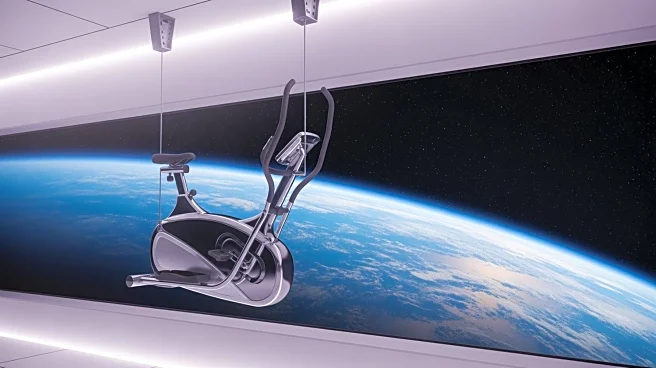
research to understand the long-term effects of spaceflight. This includes using the Bio-Monitor, a Canadian Space Agency-designed device, to track astronauts' heart and respiratory health. The data collected helps in developing medical treatments and maintaining astronaut fitness for future missions. NASA Flight Engineer Chris Williams is currently undergoing a two-day health monitoring session using the Bio-Monitor, while also exercising on the advanced resistive exercise device and the COLBERT treadmill. These activities help counteract the effects of microgravity, such as muscle and bone loss. Additionally, the crew is involved in various scientific experiments and emergency drills to ensure safety and operational efficiency aboard the ISS.
Why It's Important?
The research conducted on the ISS is crucial for preparing astronauts for long-duration missions to the Moon, Mars, and beyond. Understanding the physiological impacts of space travel allows for the development of effective countermeasures to maintain astronaut health. This research also has significant implications for Earth, as it contributes to medical advancements and the development of new technologies. The insights gained from these studies can lead to improved health monitoring systems and exercise regimens, benefiting both space travelers and people on Earth. Furthermore, the experiments conducted in microgravity can lead to innovations in various industries, including healthcare and technology, enhancing the quality of life and economic growth.
What's Next?
The ongoing research and experiments aboard the ISS will continue to provide valuable data that will inform future space missions and technological advancements. As NASA and its international partners prepare for missions to the Moon and Mars, the findings from the ISS will play a critical role in ensuring the safety and success of these missions. The collaboration between different space agencies and the continuous development of new technologies will likely lead to further breakthroughs in space exploration and related fields.