
What's Happening?
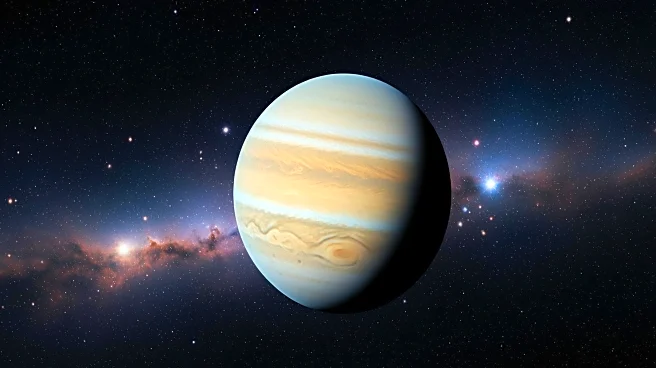
Astronomers have identified a new rogue planet drifting through the Milky Way, with a mass approximately 22 percent that of Jupiter, similar to Saturn. This discovery was made possible by combining observations
from Earth and the Gaia space telescope, allowing scientists to measure the planet's mass and determine its location. The planet is situated roughly 3,000 parsecs from the center of the Milky Way. Researchers suggest that this planet likely formed within a planetary system before being ejected due to gravitational disturbances, such as close encounters with other planets or unstable stellar companions. This finding provides new insights into the formation and evolution of free-floating planets, which are typically detected through microlensing events that briefly alter the light from distant stars.
Why It's Important?
The discovery of this rogue planet is significant as it enhances our understanding of planetary formation and the dynamics that can lead to planets being ejected from their original systems. Free-floating planets, like the one discovered, challenge traditional models of planetary systems, suggesting that many planets may exist outside the gravitational pull of a star. This has implications for the study of planetary systems and the potential for life beyond Earth. The ability to measure the mass and location of such planets through combined Earth and space observations marks a technological advancement in astronomy, paving the way for future discoveries. The upcoming NASA Nancy Grace Roman Space Telescope, set to launch in 2027, is expected to further expand our knowledge of these solitary planets.
What's Next?
Future exploratory missions, including those involving the NASA Nancy Grace Roman Space Telescope, are anticipated to increase the number of identified free-floating planets. These missions will likely employ simultaneous space- and ground-based observations to capture more detailed data on these elusive objects. As technology advances, astronomers hope to better understand the processes that lead to the formation and ejection of rogue planets, potentially uncovering new insights into the diversity and complexity of planetary systems across the galaxy.
Beyond the Headlines
The discovery of rogue planets raises questions about the potential for life on such isolated worlds. While these planets do not orbit a star, they may still possess conditions that could support life, particularly if they have internal heat sources or subsurface oceans. Additionally, the study of rogue planets could inform our understanding of the early solar system and the forces that shaped its current configuration. As more rogue planets are discovered, they may also provide clues about the frequency and distribution of planetary systems in the galaxy.