



What's Happening?
Researchers at Fudan University in Shanghai have developed electronics made from atomically thin materials that can withstand harsh radiation environments significantly longer than traditional silicon-based devices. This advancement is crucial for satellites
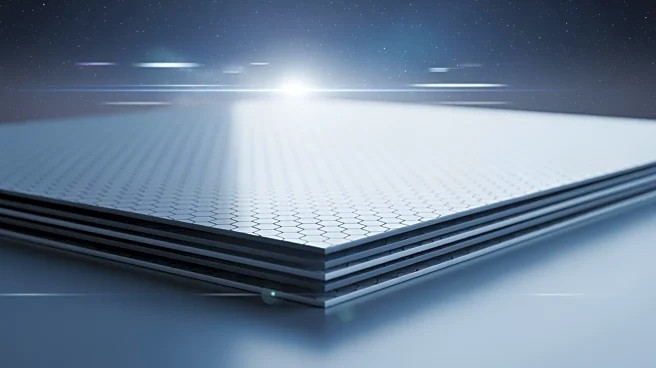
and other spacecraft, which are vulnerable to damage from cosmic radiation. The study focused on 2D molybdenum disulphide (MoS2), a material that demonstrated exceptional resistance to radiation-induced defects. The research team, led by Peng Zhou, conducted tests on these materials in space, confirming their durability and efficiency. The findings suggest that these 2D materials could be integrated into spacecraft designs to enhance their longevity and reduce costs associated with radiation shielding.
Why It's Important?
The development of radiation-resistant 2D materials for spacecraft electronics represents a significant breakthrough in space technology. Traditional silicon-based electronics are prone to damage from cosmic radiation, which can lead to increased costs and reduced lifespan of space missions. By utilizing materials like MoS2, spacecraft can achieve longer operational lifetimes and lower power consumption, which are critical for deep-space exploration and high-Earth-orbit satellites. This innovation could lead to more cost-effective and reliable space missions, benefiting industries involved in satellite communications, space exploration, and defense.
What's Next?
The research team plans to optimize these 2D materials further by employing advanced fabrication processes and circuit designs. Their goal is to enhance the performance of spaceborne radio-frequency chips used in inter-satellite and satellite-to-ground communications. Additionally, they aim to develop a radiation-tolerant computing platform based on atomic-layer semiconductors, which could support future orbital data centers and autonomous satellites. These advancements could pave the way for more sophisticated and resilient space technologies, potentially transforming the landscape of space exploration and communication.