

What's Happening?
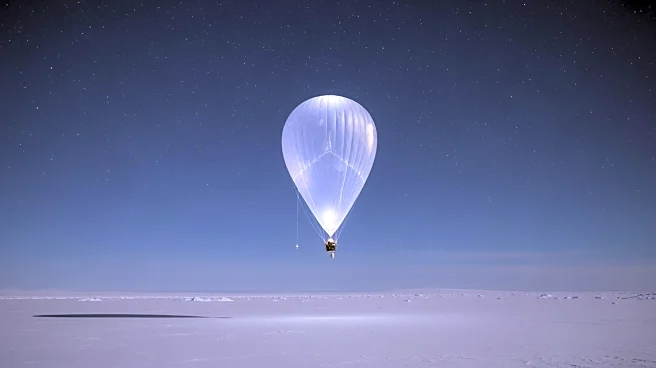
NASA has successfully completed a series of scientific balloon flights from Antarctica as part of a long-duration campaign that began in early December. The campaign involved four balloon launches from a facility near the U.S. National Science Foundation’s
McMurdo Station on the Ross Ice Shelf. The missions included the General AntiParticle Spectrometer (GAPS) and the Payload for Ultrahigh Energy Observations (PUEO). GAPS, which launched on December 15, aimed to detect anti-matter particles entering Earth's atmosphere to help understand the origins of dark matter. It flew for 25 days before returning on January 9. PUEO, launched on December 19, was designed to detect radio signals from neutrinos, high-energy particles that travel across the universe. This mission lasted 23 days, concluding on January 12. Two additional balloons were launched on December 21 to support the PUEO mission by carrying radio beacons known as HiCal, which help verify detection sensitivity.
Why It's Important?
The completion of these balloon missions is significant for astrophysics research, particularly in understanding dark matter and neutrinos. Dark matter, which constitutes over 80% of the universe's total matter, remains largely mysterious, and missions like GAPS are crucial for uncovering its properties. Similarly, the study of neutrinos through the PUEO mission provides insights into cosmic events occurring billions of light-years away. These findings could have profound implications for our understanding of the universe's fundamental forces and particles. The success of these missions also demonstrates the effectiveness of NASA's Astrophysics Pioneers program, which aims to conduct high-impact science at lower costs.
What's Next?
Following the successful completion of these missions, NASA will likely analyze the data collected to gain insights into dark matter and neutrinos. The results could lead to further scientific inquiries and potentially new missions to explore these phenomena. Additionally, the success of the Astrophysics Pioneers program may encourage more cost-effective missions in the future, expanding the scope of astrophysical research. Stakeholders in the scientific community will be keenly interested in the findings, which could influence future research directions and funding priorities.