







What's Happening?
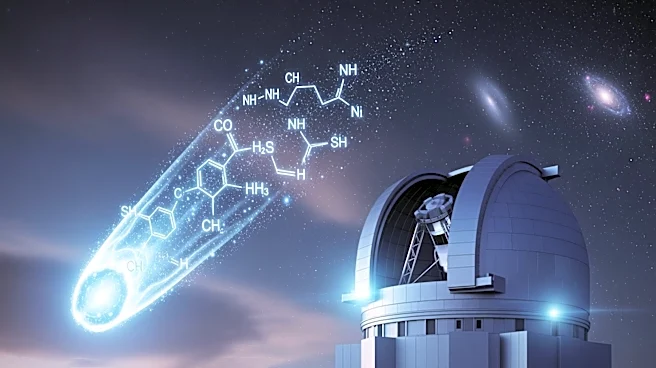
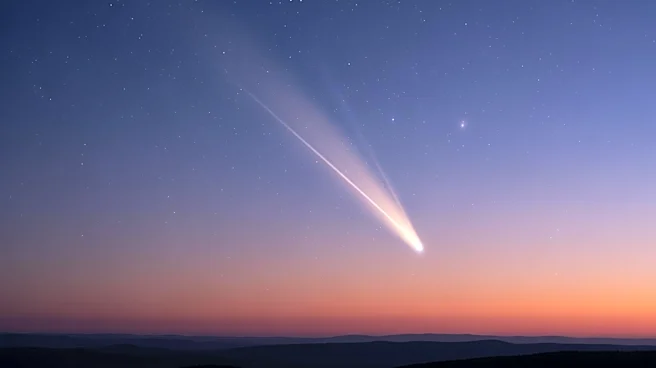
Interstellar comet 3I/ATLAS, a rare visitor from outside our solar system, is currently on its way out, having passed the orbit of Jupiter. This comet, which is over a kilometer wide, was observed using the James Webb Space Telescope (JWST) to study its mid-infrared
emissions. Researchers from Caltech have discovered that as the comet approached the sun, it began emitting methane, indicating that its outer surface had shed, revealing its inner icy layers. This observation provides insights into the comet's composition and the distant planetary system from which it originated.
Why It's Important?
The study of comet 3I/ATLAS offers a unique opportunity to understand the chemical composition of objects from outside our solar system. The presence of methane and other compounds provides clues about the environment in which the comet formed, potentially offering insights into planetary formation processes in other stellar systems. This research could enhance our understanding of the building blocks of life and the diversity of planetary systems across the galaxy.
What's Next?
The JWST is scheduled to observe comet 3I/ATLAS one more time in the spring, although it is becoming increasingly difficult to study as it moves further away. Future observations will focus on the comet's dust composition, which may reveal additional information about its origin and the conditions of its native planetary system.