







What's Happening?
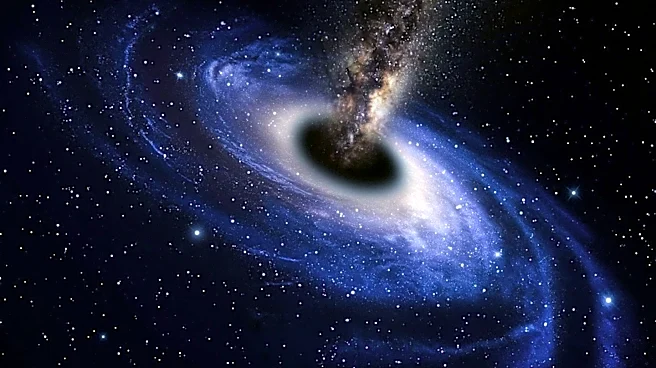
Astronomers have identified the first microblazar within the Milky Way galaxy, an object previously theorized but never observed. This system, located approximately 12,000 light-years from Earth, comprises a star and a black hole in close orbit. The black hole actively
draws matter from the orbiting star, absorbing some of it while ejecting a portion as a high-speed plasma jet directed towards Earth. This ejected plasma travels at roughly three-quarters the speed of light. According to Josep Martí, an astronomer at the University of Jaén in Spain and lead author of the study, the object was previously known but obscured by dust, preventing thorough analysis. The discovery was detailed in a new preprint study that has been accepted for publication in Astronomy & Astrophysics. This finding confirms the existence of smaller versions of blazars, which are active galactic nuclei containing supermassive black holes that also emit high-speed plasma jets.
Why It's Important?
The discovery of a microblazar in our own galaxy is significant for astrophysics and our understanding of cosmic phenomena. It provides direct evidence for a type of object that scientists had long believed to exist but had never observed. This microblazar offers a unique opportunity to study the dynamics of black holes interacting with stars and the formation of relativistic jets in a relatively close cosmic neighborhood. Understanding how these jets are formed and how they interact with the interstellar medium can shed light on the processes occurring in more distant and massive blazars. The ability to observe such a system within the Milky Way allows for more detailed study and data collection, which could refine existing models of black hole accretion and jet emission, ultimately enhancing our knowledge of galaxy evolution and high-energy astrophysical processes.
What's Next?
Following this groundbreaking discovery, astronomers plan to conduct further in-depth studies of the microblazar. Their immediate goals include investigating its evolutionary history, understanding the precise mechanisms of how its jets interact with the surrounding interstellar medium, and determining if similar microblazar systems exist elsewhere in the Milky Way. The research team will likely utilize various observational techniques and instruments to gather more data on the system's properties, such as the composition and velocity of the plasma jets, and the characteristics of the orbiting star and black hole. This ongoing research is expected to provide crucial insights into the physics of black holes and the energetic processes that shape galaxies, potentially leading to new theoretical frameworks and a more complete picture of our cosmic environment.
Beyond the Headlines
The identification of the first microblazar in the Milky Way has profound implications beyond immediate astronomical observations. It challenges previous limitations in detecting such objects, suggesting that more 'hidden' cosmic phenomena might exist within our galaxy, obscured by dust or other factors. This discovery could lead to a re-evaluation of observational strategies and data analysis techniques, potentially uncovering other previously overlooked celestial bodies. Furthermore, the study of this microblazar's high-speed plasma jets could offer insights into fundamental physics, including the behavior of matter under extreme gravitational and electromagnetic conditions. The existence of these smaller blazar counterparts within our galaxy provides a unique laboratory for understanding the universal processes that govern supermassive black holes in distant galaxies, bridging the gap between local and extragalactic astrophysics and expanding our cosmic perspective.