
What's Happening?
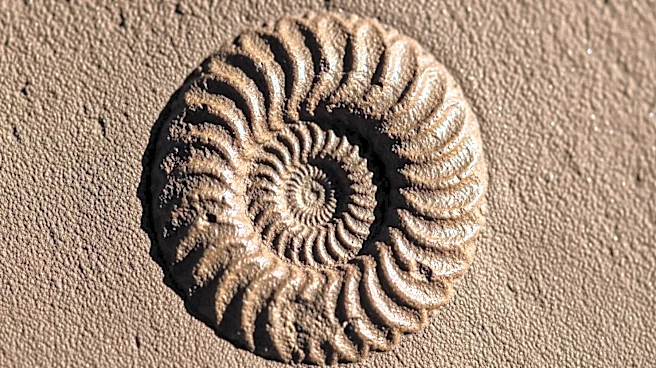
Pohlsepia mazonensis, a fossil from Illinois previously identified as the oldest known octopus, has been reclassified as a nautiloid. Initially described in 2000, the fossil was dated to the late Carboniferous
period, approximately 311 to 306 million years ago. Recent high-tech imaging tests conducted by Thomas Clements and his team at the University of Leicester revealed that Pohlsepia was not an octopus but rather a decomposed, squashed nautiloid. The fossil's misclassification was due to the unique preservation process at the Mazon Creek Lagerstätte, where high iron content in the sediment preserved soft tissues as flat, two-dimensional stains, leading to misinterpretation.
Why It's Important?
This reclassification challenges previous understandings of cephalopod evolution, suggesting that the divergence of crown coleoids, which include octopuses, squid, and cuttlefish, occurred much later during the Jurassic period. The discovery highlights the complexities of fossil interpretation and the importance of advanced imaging techniques in paleontology. It may prompt further re-evaluation of other fossils from similar geological contexts, potentially altering timelines and evolutionary pathways in scientific literature.