






What's Happening?
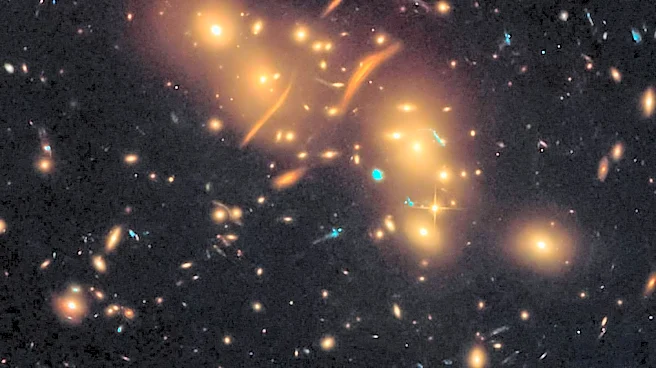
Astronomers, led by Silke Britzen at the Max Planck Institute for Radio Astronomy in Germany, have observed that the jet of a distant blazar, PKS 2233-148, appears to have been gravitationally lensed by an unseen source of dark matter. This phenomenon,
where a mass bends the path of light from a distant source, caused a sudden displacement in the blazar's jet and a fast gamma-ray flash. PKS 2233-148 is considered a likely source of cosmic neutrinos, which are chargeless, almost massless particles produced alongside electromagnetic waves in blazar jets. The team utilized high-resolution observations across the electromagnetic spectrum, including radio data from the Very Long Baseline Array (VLBA) in the U.S., gamma-ray observations from the Fermi-LAT space telescope, and X-ray detections from the Swift-XRT observatory, to precisely determine the jet's motion and variations. This marks the fourth instance of a likely cosmic neutrino source being gravitationally lensed, and the first time such an event might indicate dark matter substructure.
Why It's Important?
This discovery holds significant importance for understanding the mysterious origins of cosmic neutrinos. By identifying gravitational lensing events of blazars, which are believed to be cosmic neutrino factories, scientists can gain crucial data to link these elusive particles to their dramatic cosmic birthplaces. The ability to connect fast gamma-ray flashes with neutrino observations could help solve one of astronomy's most enduring puzzles. Furthermore, the potential detection of dark matter substructure through this lensing event provides a novel method for probing the distribution and nature of dark matter, a fundamental component of the universe that remains largely unobserved. This research contributes to a broader effort to refine cosmological models and deepen our comprehension of the universe's composition and evolution, impacting fields from particle physics to astrophysics.
What's Next?
The research team hopes to identify more such gravitational lensing events, which are challenging to find due to their short-term nature. By accumulating additional observations, they aim to establish stronger links between these lensing phenomena and the neutrino detections made by observatories like the IceCube Neutrino Observatory. This ongoing effort could lead to a more comprehensive understanding of the processes that trigger the release of cosmic neutrinos. Future studies will likely focus on refining observational techniques and developing more sophisticated models to interpret these complex astrophysical events, potentially leading to breakthroughs in our understanding of both dark matter and high-energy astrophysics.
Beyond the Headlines
The gravitational lensing of PKS 2233-148 by dark matter highlights the profound influence of unseen matter on the observable universe. This event underscores the power of general relativity, as predicted by Albert Einstein, in shaping cosmic phenomena. The detection of dark matter substructure through such lensing could provide empirical evidence for theoretical models of dark matter distribution, potentially revealing new properties of this enigmatic substance. This research also emphasizes the interdisciplinary nature of modern astrophysics, combining radio, gamma-ray, and X-ray astronomy with neutrino detection to unravel cosmic mysteries. The implications extend to our fundamental understanding of the universe's structure, evolution, and the forces that govern it, pushing the boundaries of scientific inquiry into the unseen realms of space.