
What's Happening?
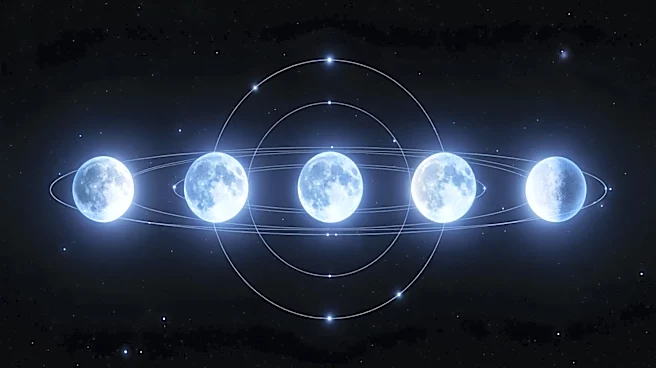
The Galilean moons of Jupiter—Io, Europa, Ganymede, and Callisto—have been a focal point for understanding planetary systems since their discovery by Galileo Galilei in 1610. These moons are locked in a 4:2:1
orbital resonance, which affects their orbits and internal dynamics. The Voyager missions in 1979 revealed intense geological activity on these moons, including Io's volcanism and Europa's potential subsurface ocean. The Galileo spacecraft further explored these moons from 1995 to 2003, confirming subsurface oceans on Europa and Callisto and revealing Ganymede's magnetic field. These findings have expanded the understanding of planetary habitability and the potential for life beyond Earth.
Why It's Important?
The study of the Galilean moons provides critical insights into the processes that govern planetary systems. The presence of subsurface oceans on Europa and Ganymede suggests that these moons could harbor conditions suitable for life. Understanding the tidal interactions and orbital dynamics of these moons can inform models of planetary formation and evolution. The findings also have implications for the search for life in the universe, as they highlight the potential for habitable environments beyond the traditional 'habitable zone' around stars.
What's Next?
Future missions to the Galilean moons aim to further explore their internal structures and the dynamics of their subsurface oceans. These missions will provide detailed data on the moons' orbits, internal layers, and tidal responses, offering new insights into their geological histories and potential habitability. The continued exploration of these moons will enhance the understanding of the complex interactions between planetary bodies and their environments.