








What's Happening?
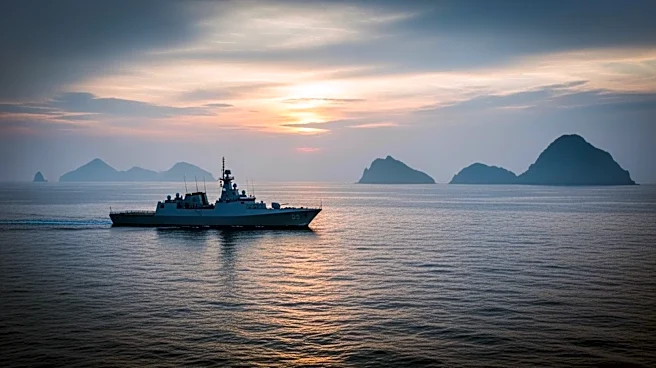
The Chinese Navy recently engaged in a military encounter with the Dutch warship HNLMS De Ruyter in the South China Sea, a region known for its complex territorial disputes. The incident occurred near the Paracel Islands, which are claimed by China but
also contested by other nations. China accused the Dutch vessel of violating its territorial sovereignty and maritime security by entering the disputed waters and conducting helicopter sorties. The Dutch Navy, however, maintains that the frigate was operating in accordance with international law and in waters where free movement is permitted. This confrontation underscores the ongoing tensions in the South China Sea, where China asserts extensive territorial claims through its controversial nine-dash line, a claim that has been rejected by an international tribunal in The Hague.
Why It's Important?
This incident highlights the growing international resistance to China's expansive territorial claims in the South China Sea, a critical maritime region for global trade and military strategy. The Dutch Navy's actions, supported by other Western governments, including the United States, reflect a broader commitment to upholding international maritime law and freedom of navigation. The South China Sea is a strategic waterway with significant geopolitical implications, as it is a major shipping route and a potential flashpoint for military conflict. The presence of Western naval forces in the region is seen as a counterbalance to China's increasing militarization and assertiveness, which could lead to heightened tensions and potential miscalculations.
What's Next?
The incident is expected to be a topic of discussion at the upcoming Shangri-La Dialogue in Singapore, Asia's largest annual defense forum. Key defense leaders, including U.S. Defense Secretary Pete Hegseth and Dutch defense chief Onno Eichelsheim, are scheduled to speak at the event. The forum will likely address the broader implications of China's actions in the South China Sea and the international community's response. Additionally, the Dutch Navy's continued presence in the region, as part of its five-month mission focused on regional security cooperation, suggests that similar encounters may occur in the future as Western nations continue to challenge China's territorial claims.
Beyond the Headlines
The incident reflects the broader geopolitical dynamics in the Indo-Pacific region, where the South China Sea serves as a stage for power projection and strategic posturing by both regional and extra-regional powers. China's assertive actions are part of its broader strategy to solidify its claims and expand its influence, while Western nations, through freedom of navigation operations, aim to uphold international norms and counterbalance China's rise. This ongoing contest for influence in the South China Sea could have long-term implications for regional stability, international maritime law, and the balance of power in the Indo-Pacific.