


What's Happening?
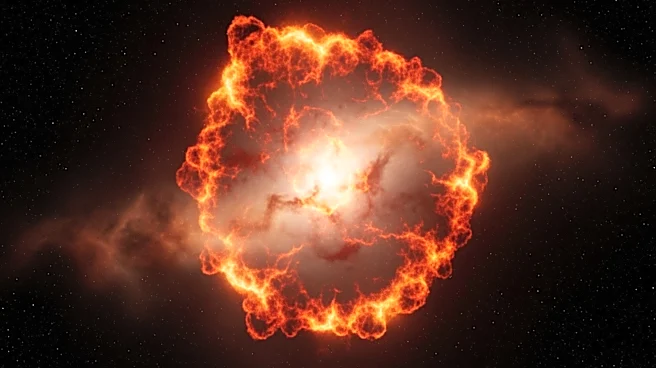
Astronomers have potentially observed a 'dirty fireball' star explosion for the first time, a phenomenon theorized over 30 years ago. This event was detected by Xiang-Yu Wang and his team at Nanjing University using the Einstein Probe telescope. The explosion,
identified as EP241113a, occurred in a galaxy approximately 9 billion light years away and emitted X-rays instead of the typical gamma rays associated with such stellar events. This suggests that the jet of radiation from the dying star was contaminated with heavier matter, slowing it down and altering its emission. The discovery could provide new insights into the processes involved in the death of massive stars and the formation of black holes.
Why It's Important?
The observation of a 'dirty fireball' could significantly enhance our understanding of how massive stars die and the conditions that lead to different types of stellar explosions. This discovery challenges existing models of gamma ray bursts and suggests that there may be a wider variety of such events than previously thought. It also highlights the potential for observational biases in detecting these cosmic phenomena. Understanding these processes is crucial for astrophysics, as it could lead to a more comprehensive picture of black hole formation and the lifecycle of stars, impacting theories about the evolution of the universe.
What's Next?
Further verification is needed to confirm the nature of the 'dirty fireball' and its distance from Earth. If confirmed, this could lead to a reevaluation of current models of stellar explosions and gamma ray bursts. Researchers will likely continue to use advanced telescopes to search for similar events, which could provide additional data to refine existing theories. The scientific community may also explore the implications of this discovery for understanding the distribution and frequency of different types of stellar explosions across the universe.