
What's Happening?
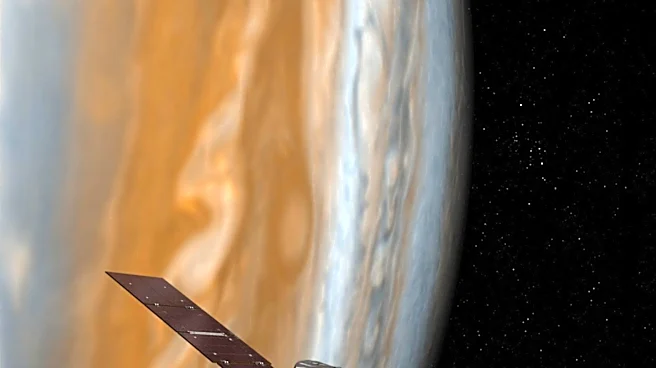
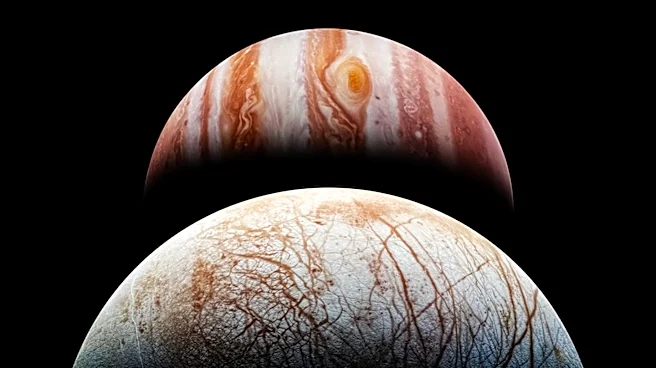
Recent measurements from NASA's Juno mission reveal that Jupiter's moon Europa has a thick ice shell, estimated to be 29 kilometers deep, covering a vast saltwater ocean. This finding suggests that the
ice is thicker than previously thought, posing significant challenges for future missions aiming to explore the ocean beneath. The data was collected using Juno's Microwave Radiometer, which measured the ice's thickness by analyzing microwave emissions. This discovery shifts the scientific debate towards a thicker ice shell, complicating efforts to study Europa's potential habitability.
Why It's Important?
Europa's ocean is considered one of the most promising places to search for extraterrestrial life due to its potential for harboring life-supporting conditions. However, the thick ice shell presents a formidable barrier to exploration, making it difficult to access the ocean and study its chemistry. Understanding the ice's thickness is crucial for planning future missions, such as NASA's Europa Clipper, which aims to investigate the moon's habitability. The findings also highlight the need for advanced technology to penetrate the ice and gather data from the ocean below.
What's Next?
NASA's Europa Clipper mission, set to arrive at Jupiter in 2030, will conduct detailed flybys of Europa to gather more data on the ice shell and the ocean beneath. The mission will use radar and other instruments to map the ice's thickness and composition, providing insights into the moon's geological activity and potential for life. The thick ice shell may require innovative approaches to explore the ocean, such as developing new drilling technologies or finding natural openings in the ice. The mission's findings will inform future exploration strategies and the search for life beyond Earth.