








What's Happening?
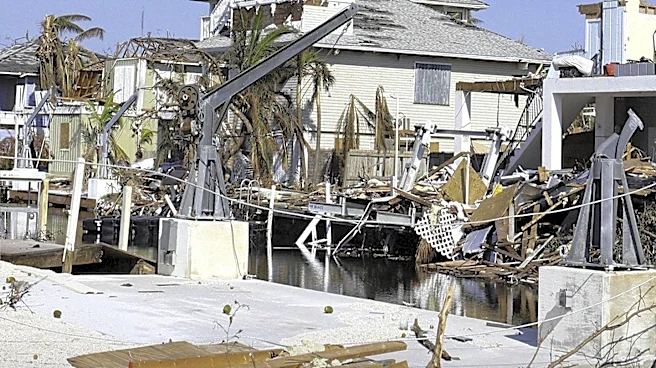
A recent report indicates that homeowners in Black and Hispanic communities across the U.S. are facing significantly higher home insurance costs compared to their white counterparts. This disparity is exacerbated by the increasing frequency of severe
weather events linked to climate change. The Consumer Federation of America's analysis found that homeowners in predominantly Hispanic ZIP codes pay, on average, 30% more annually ($950) for identical coverage, while those in predominantly Black ZIP codes pay 16% more annually ($500). The report highlights that these inequities persist even when accounting for local risk factors, suggesting a potential legacy of redlining in the insurance industry. For instance, in Florida, Hispanic homeowners pay 58% more ($5,014 annually) than white homeowners for the same coverage. Similarly, in Michigan, Black homeowners pay 74% more ($1,768 annually). The cost of typical homeowner insurance has risen by 24% between 2021 and 2024, driven by climate-related risks.
Why It's Important?
This issue is critical because it places an undue financial burden on communities of color, hindering their ability to maintain homeownership and recover from climate-related disasters. The report suggests that historical practices like redlining continue to impact these communities, leading to less affordable insurance options. The increased costs, totaling at least $28,500 over a 30-year mortgage for Hispanic homeowners and $15,000 for Black homeowners, contribute to an affordability crisis. While the insurance industry asserts that premiums are based on risk and not race, the report raises concerns about the potential for inadvertent discrimination through new proprietary methods, including AI, and the impact of factors like lower credit scores, which disproportionately affect communities of color due to structural factors. This situation undermines efforts towards equitable housing and economic stability for minority groups.
What's Next?
The report calls for states to enforce fair housing laws more rigorously and demand greater transparency and accountability from the insurance industry regarding their premium-setting practices. Stakeholders, including consumer advocacy groups and policymakers, are likely to push for investigations into how insurance rates are determined and whether current models, particularly those incorporating artificial intelligence, inadvertently perpetuate discriminatory outcomes. The insurance industry may face increased scrutiny and pressure to demonstrate that their risk assessment models are free from racial bias. Discussions will likely continue on how to make insurance more affordable and equitable, potentially through resilience efforts, strengthened building codes, and increased mitigation funding, as suggested by the Insurance Information Institute.
Beyond the Headlines
The disproportionate insurance costs for Black and Hispanic homeowners reveal deeper systemic issues beyond just climate change and insurance pricing. It highlights the enduring legacy of historical discriminatory practices like redlining, which, despite being outlawed, continue to manifest in economic disparities. The potential for bias in AI-driven insurance models also raises ethical concerns about how technology can inadvertently exacerbate existing inequalities if not carefully designed and monitored. This situation underscores the complex interplay between environmental justice, racial equity, and economic policy, suggesting that solutions must address not only the immediate financial burden but also the underlying structural factors that create and perpetuate these disparities. The lack of transparency in insurance pricing further complicates efforts to identify and rectify discriminatory practices.