





What's Happening?
NASA's Transiting Exoplanet Survey Satellite (TESS) has identified a new exoplanet, Gaia23bra b, which is 1.6 times the size of Jupiter and located nearly 40,000 light-years from Earth. This discovery was made possible through a phenomenon known as microlensing,
where light from a distant star is bent by the gravitational field of a closer star. The planet orbits an orange dwarf star, which is about 80% the mass of the Sun. This finding is significant as it extends beyond TESS's usual search radius of 150 light-years, showcasing the satellite's unexpected capability to detect such distant planets. The discovery was initially made by the European Space Agency's Gaia Telescope and later confirmed by TESS. The study, led by Mallory Harris from the University of New Mexico, was published in The Astrophysical Journal Letters.
Why It's Important?
The discovery of Gaia23bra b highlights the potential for finding more distant exoplanets using microlensing, a method that has revealed less than 5% of known exoplanets. This expands the scope of TESS's capabilities and suggests that there may be more undiscovered planets in its data. The finding also underscores the importance of international collaboration in space exploration, as the initial detection was made by the European Space Agency's Gaia Telescope. The ability to identify such distant planets could provide new insights into planetary formation and the diversity of planetary systems in the galaxy, potentially influencing future space missions and research priorities.
What's Next?
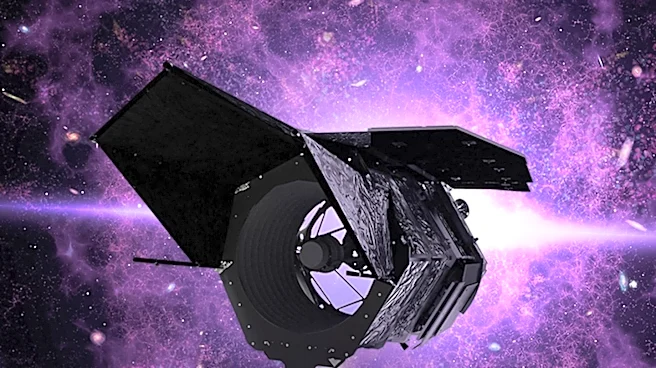
NASA's upcoming Nancy Grace Roman Space Telescope, set to launch later this year, will further explore the center of the Milky Way galaxy, aiming to reveal an estimated 1,000 microlensing planets and around 100,000 transiting planets. This mission will build on the findings from TESS and could significantly increase the number of known exoplanets, enhancing our understanding of the universe. The continued analysis of TESS data may also lead to the discovery of additional microlensing planets, prompting further studies and potentially new missions to explore these distant worlds.