
What's Happening?
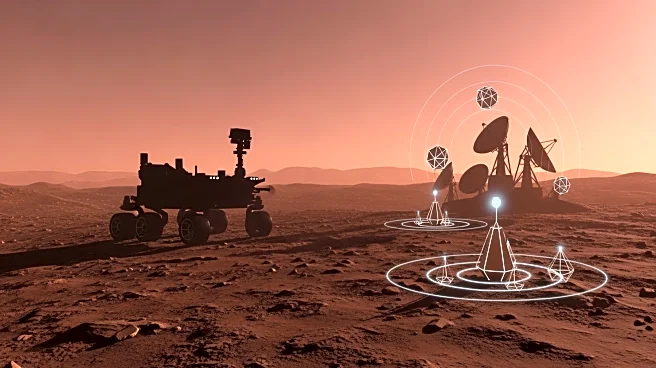
NASA has equipped its Perseverance rover on Mars with a new capability called Mars Global Localization, allowing it to determine its precise location without relying on Earth-based instructions. This development marks a significant advancement in the
rover's autonomy, as it can now match its panoramic imagery to onboard orbital terrain maps to calculate its position. Previously, the rover depended on human guidance from Earth, which involved communication delays due to the vast distance between the planets. The new system enables the rover to continue its planned route without waiting for confirmation from Earth, enhancing its ability to explore and conduct scientific research on Mars.
Why It's Important?
The introduction of autonomous navigation for the Perseverance rover represents a major leap in space exploration technology. By reducing reliance on Earth-based instructions, the rover can cover more ground and conduct more extensive scientific investigations. This capability not only increases the efficiency of the current mission but also sets a precedent for future robotic explorers on Mars and other celestial bodies. The technology could lead to faster and more autonomous exploration, potentially accelerating the pace of discoveries in space science. This advancement also highlights the growing role of artificial intelligence in space missions, paving the way for more sophisticated and independent robotic explorers.
What's Next?
With the successful implementation of Mars Global Localization, NASA may consider applying similar technologies to other missions, enhancing the autonomy of future rovers. The increased efficiency in navigation could lead to more ambitious exploration goals, such as traversing more challenging terrains or covering larger areas. Additionally, the success of this technology could influence the design and planning of upcoming missions, potentially incorporating more AI-driven solutions to overcome the challenges of space exploration. As the Perseverance rover continues its mission, it will likely gather more data and insights, contributing to our understanding of Mars and informing future exploration strategies.