








What's Happening?
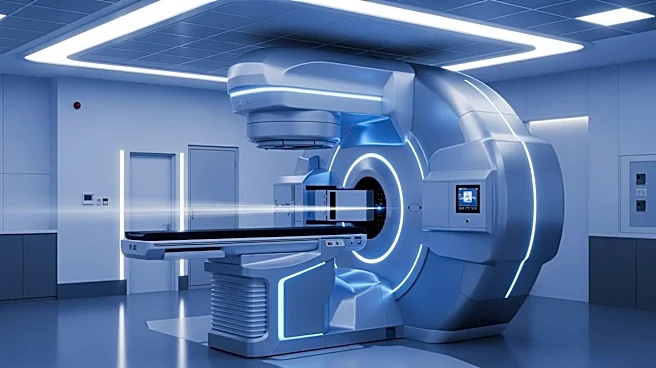
Mevion Medical Systems has announced the successful completion of the first clinical treatment using its MEVION S250-FIT Proton Therapy System at Stanford Medicine Cancer Center. This marks a significant milestone as it is the first time a proton therapy
treatment has been delivered within an existing conventional radiation therapy vault. The MEVION S250-FIT system is a compact, single-room proton therapy solution that integrates seamlessly into existing radiation oncology infrastructure, eliminating the need for constructing dedicated proton therapy bunkers. This innovation addresses space constraints and accelerates the integration of advanced particle therapy into existing oncology programs. The system pairs Mevion’s compact fixed-beam proton delivery with Leo Cancer Care’s MARIE platform, which offers 360-degree patient rotation and integrated upright CT imaging, thus removing the need for a rotating gantry and reducing the structural footprint.
Why It's Important?
The introduction of the MEVION S250-FIT Proton Therapy System represents a transformative shift in the field of radiation oncology. By eliminating the need for extensive infrastructure modifications, this system makes proton therapy more accessible to a wider range of healthcare facilities. This could significantly increase the availability of advanced cancer treatment options, particularly in areas where space and financial resources are limited. The system's compact design and integration capabilities could lead to broader adoption of proton therapy, potentially improving patient outcomes by providing more precise and effective cancer treatments. This development also positions Mevion as a leader in the field, potentially influencing future trends in radiation therapy technology.
What's Next?
Following the successful implementation at Stanford, Mevion plans to expand the deployment of the MEVION S250-FIT system across North America, Europe, and Asia. Future installations are expected at institutions such as BayCare, Atlantic Health System, and the University of Nebraska Medical Center, among others. This expansion is part of a broader movement towards infrastructure-compatible proton therapy programs that aim to optimize capital investment and support long-term clinical scalability. As more healthcare systems adopt this technology, it is anticipated that the accessibility and affordability of proton therapy will improve, potentially leading to a paradigm shift in cancer treatment protocols.