






What's Happening?
A new report from the Defense Intelligence Agency (DIA) indicates that China is significantly expanding its arsenal of counter-space weapons, including the development of on-orbit systems. The third edition of the DIA's 'Challenges to Security in Space'
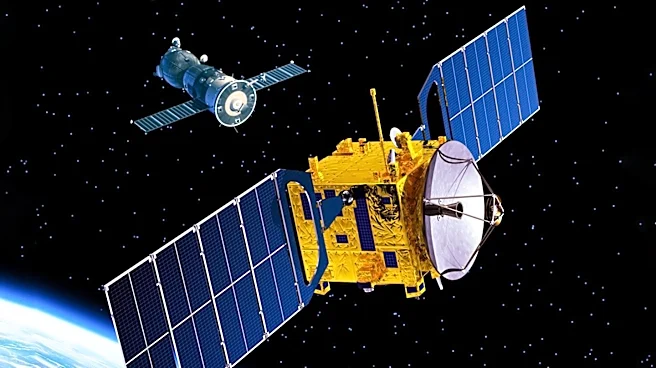
report, released on October 26, 2026, highlights that China is developing space-based technology capable of holding other space systems at risk. Specifically, the report warns that by the late 2020s, China may deploy space-based directed energy systems and more powerful ground-based directed energy systems that could threaten satellites in higher orbits. For the first time, the DIA report also notes the existence of on-orbit electronic warfare jamming systems developed by China. These systems, combined with ground-based capabilities, provide China with various options during a conflict. The report also states that Chinese firms are developing electronic jammers to target synthetic aperture radar, including military reconnaissance platforms, a capability previously only speculated. Additionally, China probably intends to deploy more anti-satellite missiles capable of destroying satellites in low, medium, and high orbits.
Why It's Important?
This development is critically important for U.S. national security and global stability. China's expansion of on-orbit counter-space weapons poses a direct threat to U.S. and allied space assets, which are vital for military operations, intelligence gathering, communication, and navigation. The ability to disrupt, degrade, or destroy satellites could significantly impact military effectiveness and civilian infrastructure reliant on space-based services. This arms race in space necessitates a re-evaluation of U.S. space defense strategies and investments. It underscores the urgent need for enhanced resilience, redundancy, and defensive capabilities for U.S. space systems. The report's findings will likely influence U.S. defense spending, technological development, and diplomatic efforts to establish norms of responsible behavior in space. The increasing militarization of space by a major power like China could lead to a more contested and potentially dangerous operational environment, impacting everything from economic activities to international relations.
What's Next?
The DIA report's findings will likely prompt increased scrutiny and investment in U.S. counter-space capabilities and defensive measures. The U.S. Space Force has already acknowledged having on-orbit weapons for 'space control,' and this report will likely accelerate efforts to enhance these capabilities. There will be a continued focus on developing resilient and redundant space architectures to mitigate the risks posed by China's expanding arsenal. Diplomatic efforts may also intensify to establish international norms and arms control agreements for space, although achieving consensus with China on these issues remains challenging. The Pentagon's recent actions, such as the $150 million loan to Stoke Space Technologies for a new launch pad, indicate a broader strategy to bolster U.S. space infrastructure and launch capabilities. The U.S. will likely continue to invest in advanced technologies, intelligence gathering, and international partnerships to maintain its advantage and ensure the security of its space assets.
Beyond the Headlines
The development of on-orbit counter-space weapons by China signifies a profound shift in the nature of warfare, extending the battlefield into outer space. This 'new space race' is not just about exploration or commercial advantage but about strategic dominance and the ability to project power from orbit. The ethical implications of weaponizing space are immense, raising concerns about the potential for devastating orbital debris fields from kinetic attacks, which could render certain orbits unusable for generations. The lack of clear international legal frameworks governing space warfare exacerbates these risks, creating a dangerous vacuum where actions could escalate rapidly. This situation demands a global dialogue on the responsible use of space, the establishment of clear red lines, and the development of verification mechanisms to prevent an unchecked arms race. The long-term stability of Earth's orbital environment and the continued benefits of space technology for humanity depend on addressing these complex challenges proactively and collaboratively.