





What's Happening?
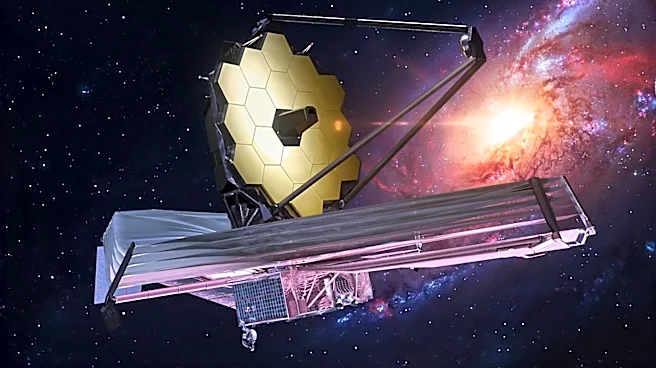
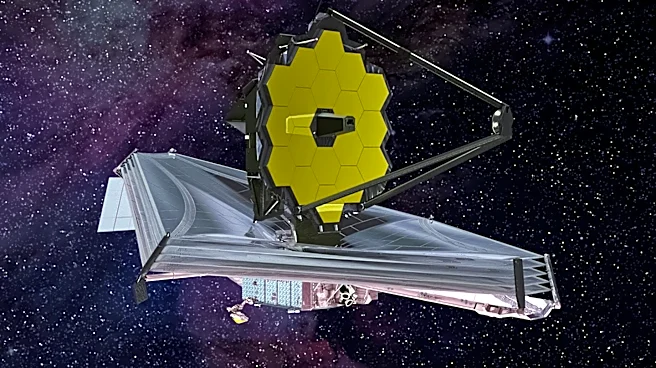
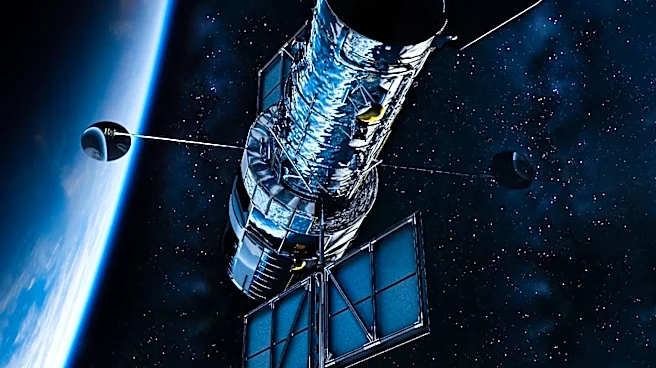
The James Webb Space Telescope (JWST) has observed a cold, free-floating brown dwarf named WISE 0855, located approximately 7.5 light-years from Earth. Over an eleven-hour period, the JWST's Near-Infrared Spectrograph collected 44 spectra, each representing
fifteen minutes, revealing dynamic atmospheric conditions. The observations indicate the presence of shifting water clouds and variations in atmospheric chemistry, specifically carbon monoxide and phosphine. These findings suggest that the thickness of patchy water clouds changes, and deeper, hotter layers are mixing, preserving gases associated with warmer conditions. This phenomenon, known as disequilibrium chemistry, is similar to processes observed on Jupiter, where internal heat drives the upward movement of atmospheric gases. The study, led by Brittany Miles of the University of Arizona's Steward Observatory, has been accepted by The Astronomical Journal.
Why It's Important?
This discovery is significant for understanding planetary weather models beyond our solar system. WISE 0855, being the coldest known brown dwarf, offers a unique opportunity to study atmospheric processes like cloud formation, convection, and chemical reactions in a planet-like environment without the influence of a host star. The ability of JWST to detect subtle changes in the atmosphere, such as temperature differences of around one kelvin, demonstrates its advanced sensitivity. The findings challenge existing atmospheric models, exposing their shortcomings and providing crucial data for refinement. This research can inform future studies of giant exoplanets, helping scientists to better interpret the light signals from distant worlds and understand their atmospheric compositions and dynamics. The insights gained from WISE 0855 contribute to a broader understanding of how atmospheres evolve and function across different celestial bodies.
What's Next?
Future research will focus on refining atmospheric models to better reconcile the observed chemical measurements, particularly the unexpectedly low abundance of phosphine. Scientists will also aim to determine a definitive rotation period for WISE 0855, as current observations provide only hints and do not yield a consistent period when compared with earlier data. Longer observations and repeat visits with the JWST are planned to resolve these uncertainties, allowing researchers to track persistent atmospheric patterns and understand the evolution of the brown dwarf's atmosphere. These continued studies will further strengthen WISE 0855's role as a crucial testbed for atmospheric physics, providing valuable lessons that can be applied to the study of giant exoplanets and other cold worlds.
Beyond the Headlines
The study of WISE 0855's atmosphere delves into the fundamental processes governing celestial bodies that exist between stars and planets. The concept of disequilibrium chemistry, where material moves faster than chemical reactions can adjust its composition, highlights the complex interplay of dynamics and chemistry in cold atmospheres. This research not only expands our knowledge of individual objects but also contributes to the broader field of astrobiology by helping to define the conditions under which different types of atmospheres can form and sustain. Understanding these processes is crucial for identifying potentially habitable environments in the universe, even if WISE 0855 itself is not considered habitable. The continuous refinement of atmospheric models based on these observations pushes the boundaries of our scientific understanding of the cosmos.