



What's Happening?
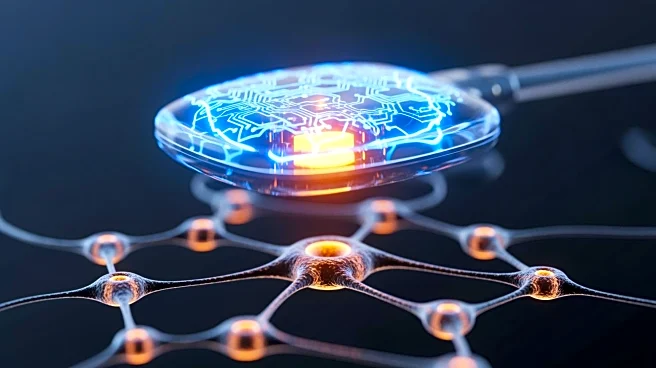
Researchers at the University of Massachusetts Amherst have developed an artificial neuron capable of operating at the same voltage range as living nerve cells, allowing it to communicate directly with human brain cells. This innovation bridges the gap
between electronic circuits and biological systems, enabling devices to interact with living cells using the same electrical language. The artificial neuron, which operates at around 0.1 volts, mimics the voltage levels, timing patterns, and energy use of biological neurons. This advancement could pave the way for circuits that link directly with cellular activity, overcoming previous barriers posed by higher voltage requirements in artificial neurons.
Why It's Important?
This development represents a significant step forward in bioelectronics, potentially revolutionizing how electronic devices interact with biological systems. By matching the electrical characteristics of natural neurons, these artificial neurons could lead to new medical devices that seamlessly integrate with human tissue, offering new treatments for neurological disorders. The ability to communicate directly with living cells could also enhance the development of brain-machine interfaces, improving the functionality and efficiency of prosthetics and other assistive technologies.
What's Next?
The next steps involve further testing and refinement of the artificial neuron technology, particularly in real-world applications involving human tissue. Researchers will likely focus on improving the stability and longevity of these devices, as well as exploring their potential in various medical and technological fields. As the technology advances, it could lead to breakthroughs in treating neurological conditions and enhancing human-machine interactions, potentially transforming healthcare and personal technology.