


What's Happening?
French President Emmanuel Macron and South Korean President Lee Jae Myung have agreed to strengthen defense cooperation and collaborate on addressing economic and energy crises exacerbated by the ongoing conflict in Iran. During Macron's two-day state
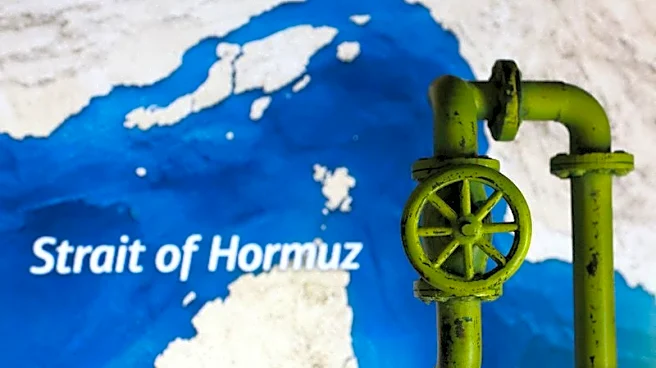
visit to South Korea, the leaders held a summit in Seoul where they discussed strategies to bolster energy security and ensure safe maritime transport routes through the Strait of Hormuz. This visit marks the first by a French president to South Korea since 2015, aiming to enhance France's strategic and economic influence in the region amidst heightened international tensions. The two countries plan to expand cooperation in security fields such as aerospace and defense, and are set to sign preliminary agreements in sectors including critical minerals, semiconductors, quantum technologies, nuclear energy, and wind power.
Why It's Important?
The agreement between France and South Korea to deepen defense cooperation is significant in the context of rising global tensions and economic instability. The collaboration aims to address the energy security challenges posed by the conflict in Iran, which has led to the closure of the Strait of Hormuz, a critical route for energy imports. This development could have far-reaching implications for global energy markets and economic stability, particularly for countries heavily reliant on energy imports like South Korea. The partnership also reflects a strategic alignment between France and South Korea to enhance their military capabilities and economic resilience in response to regional threats. The planned increase in bilateral trade and cooperation in advanced technologies could further strengthen economic ties and contribute to regional stability.
What's Next?
France and South Korea are expected to formalize their cooperation through the signing of preliminary agreements in various sectors. The focus will be on enhancing military production capabilities and expanding trade, with a target to increase bilateral trade to $20 billion by 2030. The collaboration in securing maritime routes and energy supplies will likely continue to be a priority, as both countries navigate the challenges posed by the Middle East conflict. The international community, particularly U.S. allies, may also respond to these developments, potentially influencing broader geopolitical dynamics and economic policies.