




What's Happening?
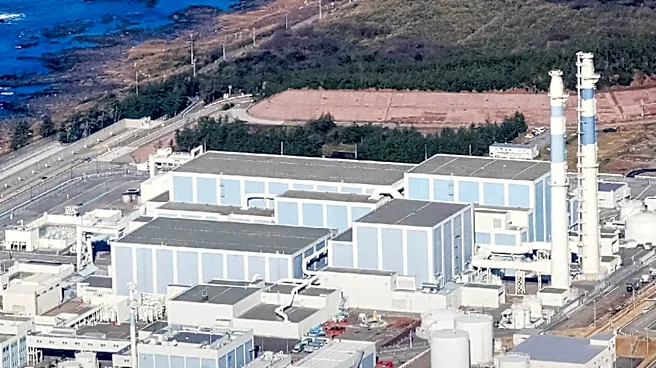
Powerful surf and flooding along Southern California's coast are intensifying fears regarding the storage of 3.6 million pounds of spent nuclear fuel at the decommissioned San Onofre Nuclear Generating Station. The high-level radioactive waste is currently
stored in steel canisters on a concrete pad, merely 100 feet from an eroding seawall. The plant, which ceased operations in 2013 due to faulty steam generators, has had most lower-level rubble removed, and its iconic twin domes are slated for demolition in early 2027. However, the spent fuel is expected to remain at the site indefinitely. Experts like Kim McCoy, a former wave dynamics researcher, warn that rising sea levels, storm waves, and El Niño events could compromise the seawall's protective walkway, bringing the waste canisters closer to the eroding coastline. While most experts suggest there is no immediate danger, the situation highlights the ongoing challenge of managing nuclear waste.
Why It's Important?
The situation at San Onofre underscores a critical national issue: the lack of a permanent federal disposal site for nuclear waste. The failure of the Yucca Mountain project has left spent fuel stranded at approximately 80 reactor sites across the U.S., leading utilities to file yearly claims against the federal government to recoup storage expenses, costing taxpayers $2 million daily. This financial burden, coupled with environmental risks, impacts public policy and economic stakeholders. The U.S. Department of Energy's recent deals with states like Utah, Tennessee, Oklahoma, Idaho, and Louisiana to explore potential 'campus' storage sites indicate a fragmented approach to a national problem. The resistance from communities, as voiced by Carmen Valdez of Heal Utah, highlights the social and political challenges in finding acceptable long-term solutions for radioactive waste, which remains dangerous for generations.
What's Next?
Southern California Edison, the utility responsible for the San Onofre site, states it monitors temperatures, radioactivity, and canister integrity, and has committed to moving the waste to a higher elevation if sea-level rise or erosion becomes a significant threat. However, if the waste cannot be relocated, Edison may need to begin transferring fuel into new canisters by 2103. The U.S. Department of Energy's ongoing efforts to identify 'campus' storage sites in various states, including Louisiana, suggest a continued push for decentralized solutions, which may face local opposition. The broader national conversation will likely continue to revolve around the development of a comprehensive, long-term federal strategy for nuclear waste disposal, balancing economic costs, environmental safety, and community concerns. The decommissioning of the plant's domes in early 2027 will mark another phase in the site's transformation, but the core issue of spent fuel storage will persist.
Beyond the Headlines
The San Onofre situation brings to light the complex ethical and environmental dilemmas associated with nuclear energy. While nuclear power offers a low-carbon alternative for electricity generation, the long-term management of its highly dangerous waste presents a profound challenge. The indefinite storage of spent fuel at coastal sites, vulnerable to natural phenomena like erosion and seismic activity, raises questions about intergenerational equity and the responsibility to future populations. The ongoing debate also touches upon the balance between technological advancement and its unforeseen consequences, as well as the political will to invest in and implement robust, long-term solutions for hazardous materials. The resistance from communities to host waste sites reflects a broader societal distrust and the 'not in my backyard' phenomenon, complicating national efforts to address this critical infrastructure and environmental issue.