



What's Happening?
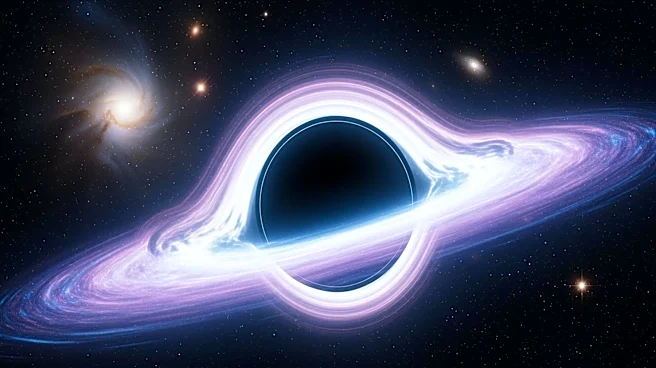
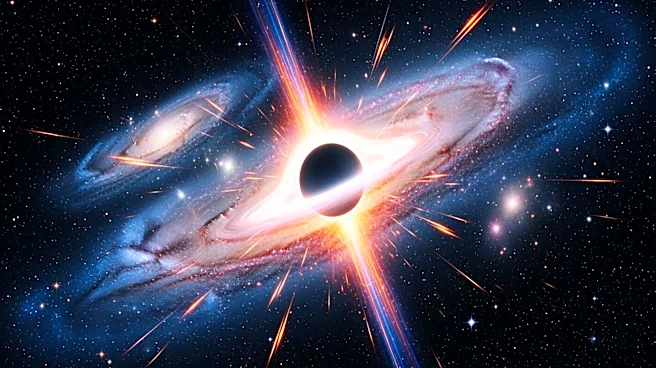
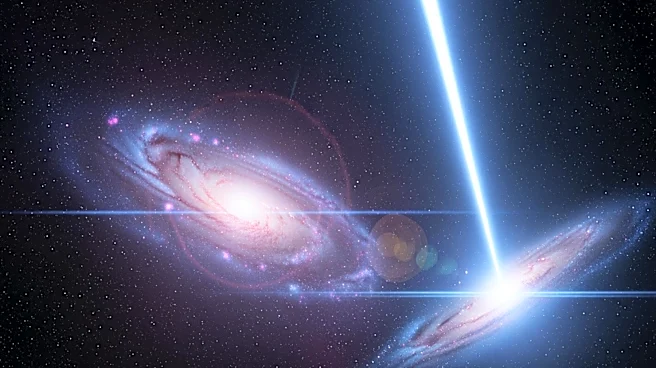
Recent observations from the James Webb Space Telescope have revealed that a supermassive black hole, identified as QSO1, likely formed before the galaxy surrounding it. This discovery challenges traditional models of galaxy formation, which typically
suggest that black holes grow within pre-existing galaxies. The research, led by Roberto Maiolino at the University of Cambridge, indicates that QSO1 existed in a 'pristine' environment, devoid of stars or stellar remnants. The study, published in the Monthly Notices of the Royal Astronomical Society, suggests that the black hole's formation occurred in the early universe, approximately 700 million years after the Big Bang. The findings propose that the black hole may have formed through a 'heavy seed' scenario, where it was already massive at birth, rather than growing from smaller 'seed' black holes.
Why It's Important?
This discovery has significant implications for our understanding of cosmic evolution and the formation of supermassive black holes (SMBHs). Traditionally, SMBHs are thought to form from the remnants of supernova explosions and grow by consuming surrounding gas. However, the early appearance of QSO1 suggests alternative formation scenarios, such as the 'heavy seed' model, where black holes form directly from the collapse of vast material clouds or from primordial black holes. This challenges existing theories and could lead to a reevaluation of how galaxies and their central black holes evolve. Understanding these processes is crucial for astronomers as they seek to unravel the mysteries of the universe's early history and the role of black holes in shaping galaxies.
What's Next?
The findings from this study open new avenues for research into the origins of supermassive black holes. Future observations and studies will likely focus on identifying other early universe black holes to determine if the 'heavy seed' scenario is a common formation pathway. Additionally, researchers may explore the conditions necessary for such massive black holes to form in the early universe. These efforts could involve further analysis of data from the James Webb Space Telescope and other astronomical instruments. The results could significantly impact our understanding of galaxy formation and the role of black holes in cosmic evolution.
Beyond the Headlines
The discovery of a supermassive black hole forming before its galaxy raises intriguing questions about the nature of the early universe. It suggests that the conditions shortly after the Big Bang were conducive to the formation of massive black holes, potentially altering our understanding of cosmic timelines. This could have implications for the study of dark matter and the overall structure of the universe. Additionally, the research highlights the importance of advanced telescopes like the James Webb Space Telescope in providing insights into the universe's earliest epochs, offering a glimpse into the processes that shaped the cosmos as we know it.