
What's Happening?
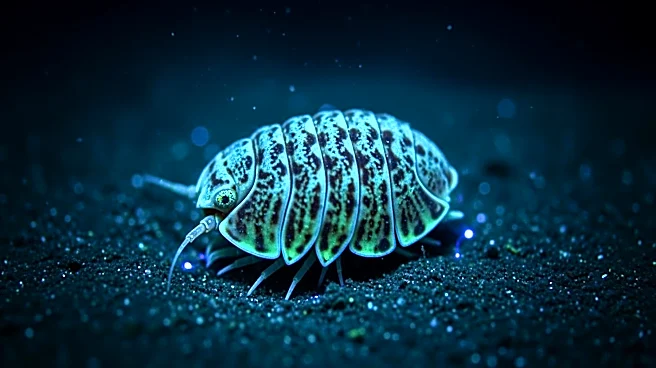
Researchers from the Institute of Oceanology of the Chinese Academy of Sciences have discovered how deep-sea supergiant isopods survive for years without food. These isopods, known for their large size,
have developed a dual survival strategy: an enlarged stomach for storing food and a low basal metabolic rate. The study, published in Cell, reveals that these adaptations allow the isopods to thrive in nutrient-poor environments. Additionally, a horizontally transferred gene, ND1, plays a crucial role in their energy metabolism, helping them manage the trade-off between energy demands and metabolic suppression.
Why It's Important?
This discovery provides insights into the evolutionary strategies of deep-sea organisms, highlighting how life can adapt to extreme environments. Understanding these mechanisms could have broader implications for studying energy metabolism and survival strategies in other species. The findings also contribute to the field of marine biology by offering a new perspective on how deep-sea creatures manage energy resources. This knowledge could inform future research on biodiversity and the resilience of marine ecosystems in the face of environmental changes.
What's Next?
The study opens avenues for further research into the genetic and physiological adaptations of deep-sea organisms. Scientists may explore the potential applications of these findings in biotechnology, particularly in developing strategies for energy conservation and metabolic regulation. Additionally, the role of horizontally transferred genes in evolution and adaptation could become a focus of future studies, providing deeper insights into genetic diversity and resilience in extreme environments.