



What's Happening?
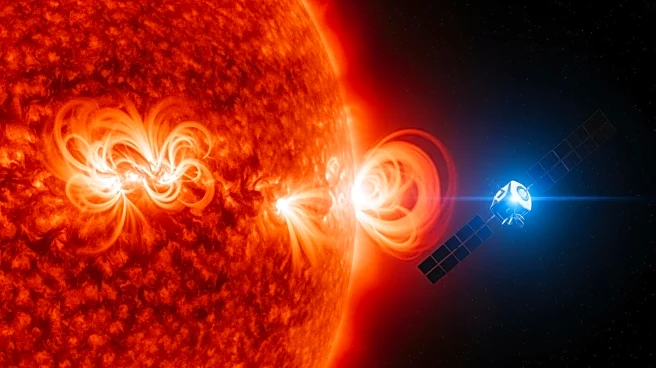
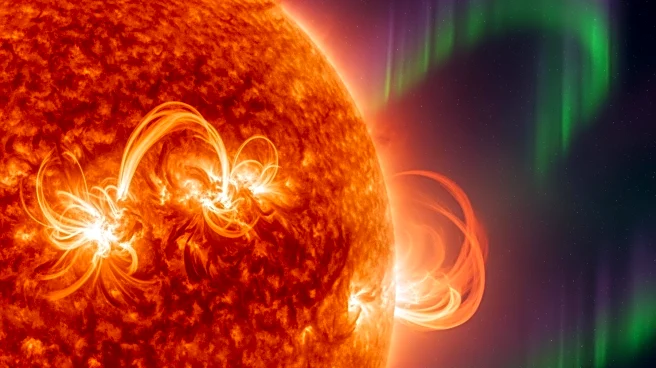
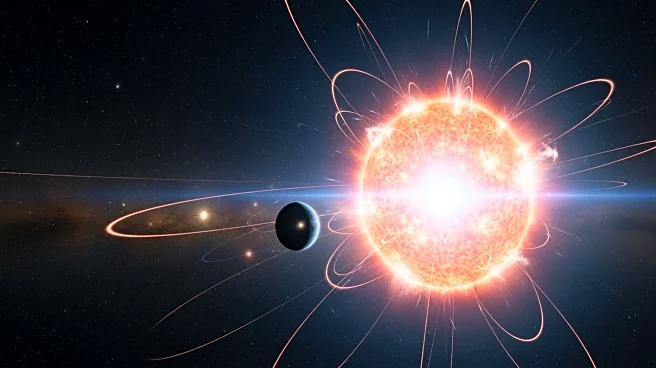
Astronomers at the Netherlands Institute for Radio Astronomy (ASTRON) have made a groundbreaking observation by detecting a coronal mass ejection (CME) from a star outside our solar system. This star, known as StKM 1-1262, is located approximately 40
light-years away from Earth and is classified as an M-dwarf star. It is significantly different from our Sun, possessing only half its mass, rotating 20 times faster, and having a magnetic field 300 times stronger. The CME detected from this star exhibited similar properties to solar type II bursts, which are fast CMEs originating from the Sun. This discovery was made possible through the use of the highly sensitive low-frequency radio telescope LOFAR, ESA’s XMM-Newton space observatory, and advanced software developed by researchers in France.
Why It's Important?
The detection of a CME from a distant star has significant implications for the study of space weather and the habitability of exoplanets. M-dwarf stars, like StKM 1-1262, are common hosts for potentially habitable exoplanets. However, the intense space weather, characterized by frequent and powerful CMEs, could strip these planets of their atmospheres, rendering them uninhabitable. This finding challenges the traditional understanding of the 'habitable zone' around stars, suggesting that even planets within this zone could be inhospitable if subjected to regular CME bombardments. The study highlights the need to consider stellar activity when assessing the potential for life on exoplanets.
What's Next?
The ASTRON team plans to search for more stars exhibiting similar CME activity to better understand the impact of such events on their environments. Future observations using the next-generation Square Kilometre Array, which offers greater sensitivity, are expected to uncover more stars like StKM 1-1262. These efforts aim to expand the knowledge of CMEs and their effects on exoplanetary atmospheres, potentially reshaping the criteria for assessing exoplanet habitability.
Beyond the Headlines
This discovery prompts a reevaluation of how life might be sustained on planets orbiting active stars. The study suggests that the presence of a protective atmosphere, like Earth's, is crucial for shielding life from the harmful effects of CMEs. The findings also underscore the importance of considering stellar activity in the search for extraterrestrial life, as planets in seemingly ideal orbits may still be inhospitable due to frequent atmospheric stripping by CMEs.