






What's Happening?
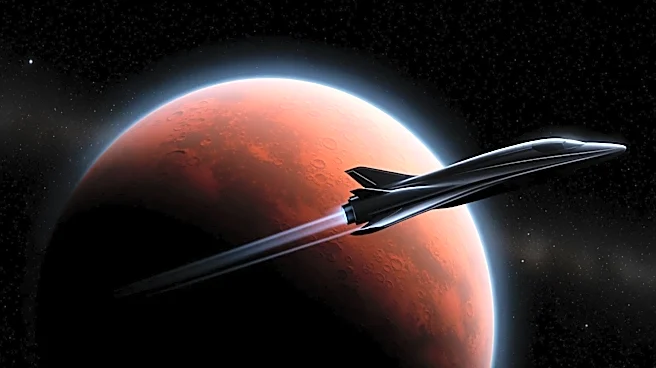
NASA's Psyche spacecraft executed a close flyby of Mars on May 15, passing within 2,864 miles of the planet's surface. This maneuver was part of its journey to the metal-rich asteroid Psyche. During the flyby, the spacecraft captured detailed images of Mars,
including the double-ring Huygens crater. The primary purpose of this flyby was to use Mars' gravity to increase the spacecraft's speed and adjust its trajectory without consuming additional fuel, a technique known as a gravity assist. This strategic move is crucial for conserving propellant for later stages of the mission. The Psyche spacecraft is expected to reach its asteroid target in August 2029, where it will begin mapping the surface and collecting scientific data.
Why It's Important?
The Psyche mission is significant as it aims to explore a metal-rich asteroid that may represent the exposed core of an ancient planetesimal. This could provide scientists with a unique opportunity to study material typically hidden deep within rocky planets like Earth. The mission's success could enhance our understanding of planetary formation and the early solar system. Additionally, the use of gravity assists demonstrates NASA's ability to efficiently navigate space missions, potentially reducing costs and extending mission lifespans by conserving fuel.
What's Next?
Upon arrival at the asteroid in 2029, the Psyche spacecraft will enter orbit and begin its scientific mission. It will map the asteroid's surface and gather data to test the hypothesis that Psyche is the core of an early planetesimal. The findings could have profound implications for our understanding of planetary cores and the history of the solar system. NASA will continue to monitor the spacecraft's journey and make necessary adjustments to ensure a successful mission.