



What's Happening?
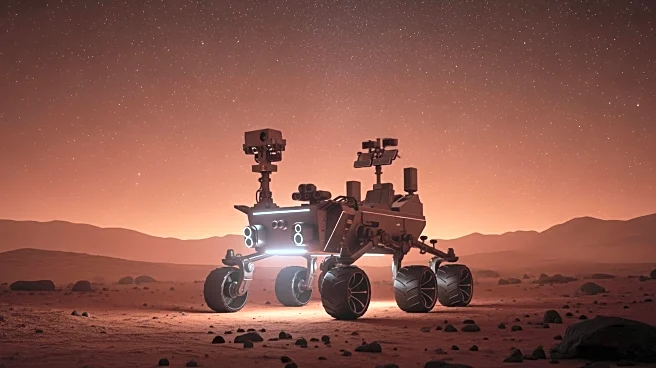
NASA has achieved a significant milestone in space exploration with the successful completion of the first-ever AI-planned rover drives on Mars. Conducted on December 8 and 10, 2025, the Perseverance rover navigated the Martian terrain using routes planned by
artificial intelligence, rather than human operators. This groundbreaking event took place along the rim of Jezero Crater, utilizing advanced AI systems to analyze the terrain, identify hazards, and generate safe driving waypoints. The AI-driven approach aims to reduce the time and effort required for planning rover movements while maintaining strict safety standards. Vandi Verma, a key figure in this achievement, serves as the Chief Engineer for Robotic Operations at NASA's Jet Propulsion Laboratory (JPL). Her role involves overseeing the integration of new autonomy tools into mission operations, ensuring the rover's safe navigation and execution of complex commands.
Why It's Important?
The success of the AI-planned rover drive represents a pivotal shift in how robotic missions could be conducted as space exploration extends further from Earth. With communication delays making real-time control challenging, the development of autonomous systems is crucial for future missions, including sustained lunar operations and eventual human missions to Mars. The ability of AI to streamline core elements of rover navigation, such as perception, localization, and planning, could significantly reduce operator workload and enhance mission efficiency. This advancement not only marks a professional achievement for Vandi Verma but also demonstrates the potential of AI to work alongside human expertise, expanding the boundaries of space exploration and paving the way for long-term human presence beyond Earth.
What's Next?
NASA officials anticipate that the success of the AI-planned drive will influence the design and operation of future robotic missions. As space agencies prepare for more complex missions, including those involving human presence on the Moon and Mars, the integration of intelligent systems across rovers, drones, and surface platforms will be essential. These systems will be critical in building the infrastructure needed for sustained exploration and habitation. The continued development and testing of AI technologies will likely focus on enhancing autonomy, safety, and efficiency, ensuring that future missions can adapt to the challenging environments encountered as distance from Earth increases.