







What's Happening?
Rownd Inc. has opened a new research and development center in Richfield, Wisconsin, focusing on artificial intelligence and autonomous drone technology. This expansion is part of the company's efforts to keep pace with the rapid advancements in defense
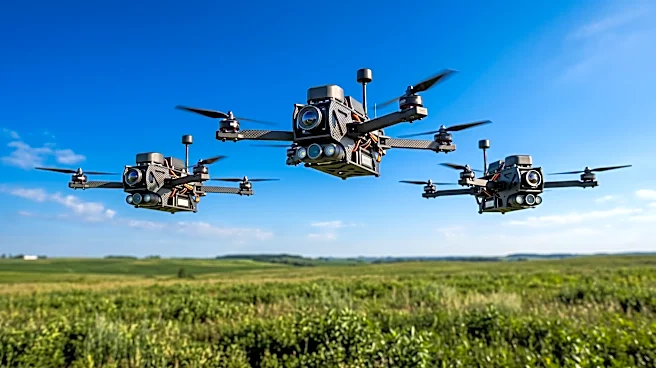
technology. Rownd Inc. recently secured a $10 million contract with the Department of War, alongside other contracts aimed at developing cost-effective, autonomous drones that can be quickly replaced if lost in combat. Robert Thelen, CEO and co-founder of Rownd, highlighted the unprecedented pace of innovation in military technology, noting that developments that once took years now occur in weeks. The company's drones are designed with onboard AI and sensors, allowing them to perform tasks autonomously without constant human control. In October, Rownd tested its autonomy software with Air Force personnel in Alabama, conducting 41 flights, including mobile and fleet tests with AI onboard, and successfully flying a drone swarm for the first time with up to three drones simultaneously. The company's approach emphasizes attritable mass, meaning deploying numerous drones that are easy to launch, control, and replace, to support continuous missions and enhance military personnel safety.
Why It's Important?
The establishment of Rownd Inc.'s R&D center in Richfield signifies a growing trend of defense technology companies expanding into non-traditional defense industry locations, creating high-growth job opportunities in new regions. This move is crucial for the U.S. to maintain technological superiority in an evolving global defense landscape, where adversaries are rapidly innovating. The focus on autonomous drone swarms and AI-driven systems reflects a strategic shift towards reducing human exposure in dangerous combat zones while increasing operational efficiency and scale. The ability to rapidly develop and deploy cost-effective, replaceable drones addresses the need for continuous adaptation against evolving threats, as seen in current conflicts. Furthermore, the company's emphasis on onboard AI for decision-making reduces reliance on constant connectivity, enhancing resilience in contested environments. This development also contributes to the broader U.S. economy by fostering innovation and creating specialized jobs in AI, robotics, and advanced manufacturing.
What's Next?
Rownd Inc. plans to continue its rapid development cycle, using field experience to make swift improvements to its software, AI models, and hardware. The company expects its expansion in Wisconsin and North Carolina to generate 22 new careers, including positions in next-generation manufacturing and autonomous systems development. Future efforts will likely focus on scaling up the deployment of autonomous drone swarms and further integrating AI to enhance decision-making capabilities and coordination among multiple unmanned aerial vehicles. The company aims to make drones increasingly autonomous while simultaneously increasing the number of drones that can operate together effectively. Rownd's technology could also see applications beyond defense, such as in agriculture for data collection, targeted fertilization, and weed control, as well as in site monitoring, indicating a broader impact on various industries as autonomous systems become more sophisticated and widespread.
Beyond the Headlines
The rapid advancements in autonomous drone technology, as exemplified by Rownd Inc.'s work, raise significant ethical and strategic considerations. The shift towards fully autonomous systems, where AI makes operational decisions, brings forth questions about accountability and the role of human oversight in warfare. The concept of 'attritable mass'—deploying numerous inexpensive, replaceable drones—could fundamentally alter military strategies, potentially leading to larger-scale, more frequent drone engagements. This also implies a continuous technological arms race, where the pace of innovation becomes a critical factor in national security. The integration of AI into defense systems also has broader societal implications, as the same underlying technologies can be adapted for civilian uses, potentially transforming industries like agriculture, logistics, and surveillance. The need for a skilled workforce in AI and autonomy engineering will likely grow exponentially, necessitating educational and training initiatives to prepare for these emerging job markets.