


What's Happening?
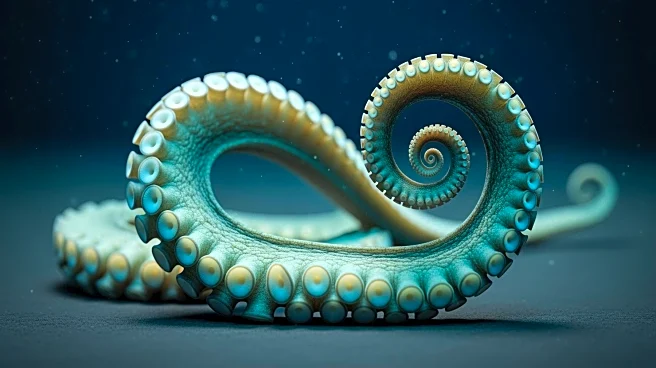
Professor Tim Coulson from the University of Oxford has proposed that octopuses could potentially replace humans as Earth's dominant species in the future. In his research, Coulson highlights the octopus's intelligence, problem-solving abilities, and
adaptability as key traits that could allow them to thrive in a post-human world. Unlike primates, which rely heavily on social networks, octopuses possess advanced neural structures and decentralized nervous systems, making them well-suited for an unpredictable environment. Coulson suggests that, given the right evolutionary conditions, octopuses could develop the ability to build underwater habitats and even adapt to terrestrial life.
Why It's Important?
This hypothesis challenges traditional views on evolution and the potential for non-mammalian species to develop complex societies. It underscores the adaptability of life and the possibility of unexpected evolutionary paths. The idea of octopuses as future dominant species prompts a reevaluation of how intelligence and civilization might manifest in different forms. This perspective can influence scientific research on evolution, biodiversity, and the resilience of ecosystems. It also serves as a reminder of the impermanence of human dominance and the potential for other species to rise in our absence.
Beyond the Headlines
Coulson's theory invites ethical and philosophical discussions about humanity's role in shaping the planet and the legacy we leave behind. It raises questions about conservation efforts and the importance of preserving diverse ecosystems that could harbor future dominant species. The concept of octopuses as potential successors also highlights the need for interdisciplinary research, combining biology, ecology, and evolutionary studies to understand the full spectrum of life's possibilities.