





What's Happening?
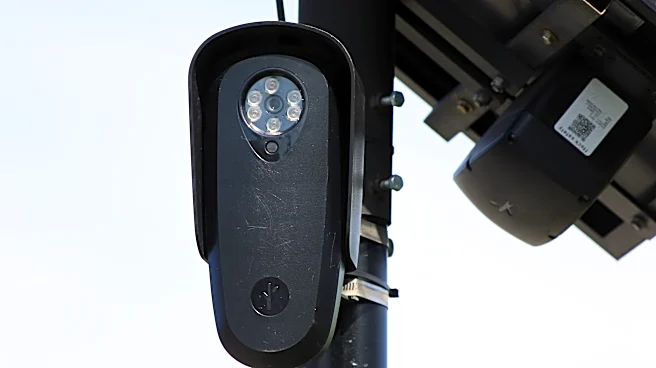
During a recent Kerrville City Council meeting, resident Clay Bennett voiced strong opposition to the city's use of automated license plate readers (ALPRs). Bennett labeled these devices as 'illegal warrantless searches,' asserting that their operation
violates the Fourth Amendment of the U.S. Constitution. His comments were made despite an explanation from Herring, who clarified that the city does not have a financial relationship with Flock, a common provider of such technology, but has utilized its own ALPRs for over a decade. Another resident, Kimber Malcolm, echoed Bennett's concerns, referring to the cameras as 'a language of tyrants.' In separate council action, a Conditional Use Permit was approved for Zion Lutheran Church to offer after-school services for up to 15 children at its 813 Clay Street property.
Why It's Important?
The debate surrounding automated license plate readers in Kerrville highlights a growing national concern regarding privacy rights and government surveillance. The Fourth Amendment protects citizens from unreasonable searches and seizures, and the deployment of ALPRs raises questions about whether continuous, widespread data collection on vehicle movements constitutes such a search without individual warrants. This issue is significant because it pits public safety interests, often cited as the justification for ALPRs, against fundamental constitutional protections. The outcome of such local discussions can influence broader legal interpretations and public policy on surveillance technologies across the U.S., potentially setting precedents for how cities balance security with civil liberties. The concerns raised by residents like Clay Bennett reflect a broader societal apprehension about the scope and implications of technological advancements in law enforcement.
What's Next?
The Kerrville City Council's response to residents' concerns about ALPRs will likely shape future discussions and potential policy adjustments regarding surveillance technology in the city. While the council has acknowledged the presence and long-standing use of these devices, the public outcry may prompt further review or public forums to address privacy implications. It is possible that residents, inspired by Clay Bennett's stance, may organize or petition for more stringent regulations or even a moratorium on ALPR use, potentially leading to legal challenges if their concerns are not adequately addressed. The ongoing dialogue could also influence other municipalities facing similar debates, as local decisions often contribute to a broader national conversation on technology, privacy, and civil liberties. The approval of the Conditional Use Permit for Zion Lutheran Church, while unrelated to the ALPR discussion, indicates the council's continued engagement with community needs and local development.
Beyond the Headlines
The controversy over automated license plate readers extends beyond immediate privacy concerns, touching upon the evolving nature of digital surveillance and its impact on democratic societies. The 'illegal warrantless searches' argument by Clay Bennett underscores a fundamental tension between technological capability and constitutional safeguards. This debate forces a re-evaluation of what constitutes 'reasonable expectation of privacy' in an era where data collection is ubiquitous. The long-term implications could include a shift in legal interpretations of the Fourth Amendment to explicitly address digital data and surveillance technologies. Furthermore, the public's reaction in Kerrville reflects a broader societal unease about the potential for 'tyranny' through technology, where data collected for one purpose could be repurposed or misused, leading to a chilling effect on civil liberties and freedom of movement. This local discussion is a microcosm of a national and even international challenge to define the boundaries of state power in the digital age.