







What's Happening?
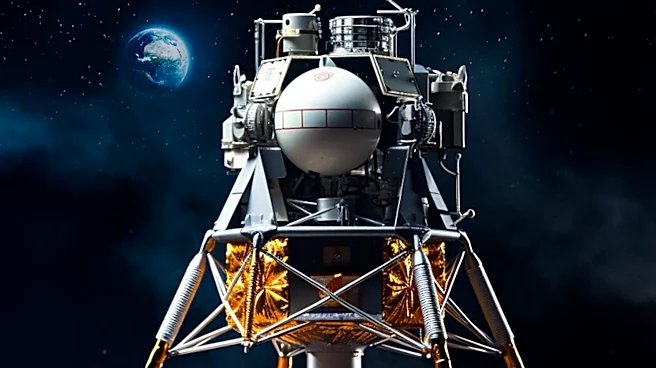
NASA has announced new contracts for lunar landers as part of its Moon Base initiative, aiming to establish a permanent human outpost on the moon. The contracts have been awarded to Astrobotic, Firefly Aerospace, and Intuitive Machines, which will provide
four robotic landers to deliver scientific payloads to the lunar surface. This initiative is part of NASA's Commercial Lunar Payload Services (CLPS) program, which plans to launch up to 20 missions by 2029. The landers will carry instruments such as the Stereo Camera for Lunar Plume Surface Studies, a Laser Retroreflector Array, and a Linear Energy Transfer Spectrometer to study various aspects of the lunar environment. Additionally, NASA is considering sending a spare Mars rover, known as PROMISE, to the moon's south pole to further its lunar exploration efforts.
Why It's Important?
The development of these lunar landers is crucial for NASA's long-term goal of establishing a sustainable human presence on the moon. By deploying scientific instruments and technology demonstrations, NASA aims to gather essential data about the lunar environment, which is vital for future human missions. The initiative also represents a significant step in international space exploration, potentially paving the way for collaborative efforts with other countries. The use of a spare Mars rover on the moon could provide valuable insights into the lunar surface, enhancing our understanding of its potential resources and challenges. This could have far-reaching implications for space policy and the future of human space exploration.
What's Next?
NASA plans to continue its lunar exploration efforts with the launch of these landers in the coming years. The agency is also exploring the possibility of sending the PROMISE rover to the moon, which would require refurbishment and adaptation for lunar conditions. As these missions progress, NASA will likely engage with international partners and private companies to expand its lunar exploration capabilities. The success of these missions could influence future funding and policy decisions related to space exploration, as well as inspire new technological innovations.
Beyond the Headlines
The decision to repurpose a Mars rover for lunar exploration highlights NASA's innovative approach to resource utilization. This move could set a precedent for future missions, where existing technology is adapted for new environments, potentially reducing costs and development time. Additionally, the focus on the moon's south pole, believed to contain water ice, underscores the strategic importance of this region for sustaining human life and supporting long-term exploration missions. The success of these initiatives could also stimulate interest in space exploration among the public and inspire the next generation of scientists and engineers.