

What's Happening?
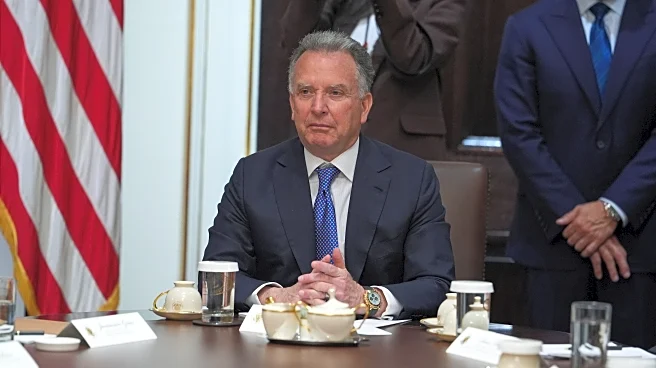
Steve Witkoff, the special Middle East envoy for U.S. President Donald Trump, addressed the annual conference of the Israeli-American Council (IAC) in Miami. During his speech, Witkoff highlighted key policy issues, including the ongoing tensions with
Iran and efforts to advance peace in Gaza. He recounted President Trump's emotional reaction when hostages released in an October deal arrived at the White House, describing it as Trump's 'greatest day' in office. Witkoff also discussed the establishment of a 'Board of Peace,' an initiative by President Trump aimed at postwar arrangements in Gaza. He noted that the U.S. has made progress in replacing Hamas's rule in Gaza, with a new government set to take over. Witkoff emphasized the shift in Hamas's stance following the hostage release, marking a significant change in the group's perception of hostages as liabilities rather than assets.
Why It's Important?
The developments discussed by Witkoff at the IAC conference have significant implications for U.S. foreign policy and Middle East stability. President Trump's emotional involvement in the hostage release underscores the administration's commitment to resolving international conflicts through diplomatic means. The creation of a 'Board of Peace' reflects a strategic move to stabilize Gaza and reduce Hamas's influence, potentially leading to long-term peace in the region. The U.S. government's efforts to replace Hamas with a new governing body could alter the geopolitical landscape, affecting regional power dynamics and U.S. relations with Middle Eastern countries. Additionally, the shift in Hamas's stance post-hostage release may open new avenues for negotiation and conflict resolution.
What's Next?
The next steps involve the implementation of the 'Board of Peace' and the transition to a new government in Gaza. The U.S. will likely continue diplomatic efforts to ensure a smooth transition and maintain stability in the region. The international community, including key stakeholders in the Middle East, will be closely monitoring these developments. Potential reactions from Iran, given the ongoing tensions, could influence the U.S.'s diplomatic strategy. The success of these initiatives may depend on continued international support and cooperation from regional partners.