







What's Happening?
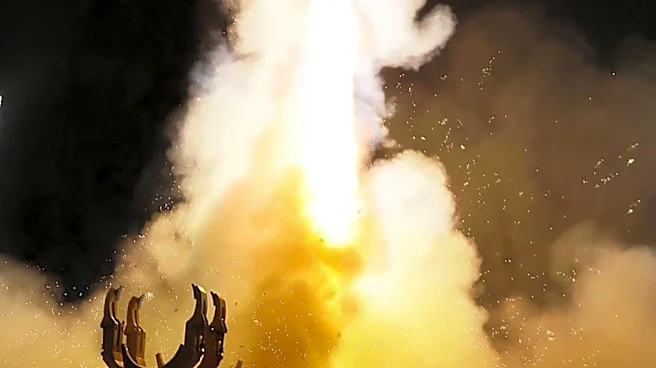
North Korea announced it conducted a test-firing of strategic cruise missiles on November 2, 2026, featuring a dispersal warhead. According to state media, KCNA, the warhead is capable of destroying a target area of 5 to 6 hectares with high-density power.
The test also reportedly improved the missile's terminal maneuverability, allowing for a vertical strike on the target area, taking into account natural and geographical characteristics. This launch follows a previous test on October 31 of cluster bomb warheads, which North Korea claims can affect an area of 12 to 13 hectares. South Korea and the United States are analyzing the test, though South Korea did not publicly announce the launch. Unlike ballistic missile tests, cruise missile tests are not prohibited by UN Security Council sanctions.
Why It's Important?
The development and testing of strategic cruise missiles with dispersal warheads by North Korea represent a significant advancement in its military capabilities. These weapons, designed to release multiple smaller explosive devices over a wide area, pose an increased threat to concentrations of personnel, vehicles, and infrastructure. The claimed ability to devastate a target area of 5 to 6 hectares suggests a potential for widespread damage, which could escalate regional tensions and alter military strategies in the Korean Peninsula. The improved terminal maneuverability for vertical strikes indicates a more sophisticated targeting system, making these missiles potentially harder to defend against. This ongoing weapons development by North Korea, particularly with systems not explicitly banned by UN sanctions, challenges international efforts to curb its nuclear and missile programs and could prompt further military responses or adjustments from South Korea, the U.S., and their allies.
What's Next?
South Korea and the United States are currently conducting a detailed analysis of the characteristics and specifications of the tested cruise missile. This analysis will be crucial in understanding the true capabilities of the new weapon system and informing future defense strategies. The continued development of such weaponry by North Korea is likely to lead to increased surveillance and intelligence gathering by regional powers. While cruise missile tests are not under UN sanctions, the nature of the dispersal warhead could prompt international discussions and potential diplomatic pressure. The situation may also lead to further military exercises or demonstrations by South Korea and the U.S. to deter North Korean aggression and reassure allies in the region.
Beyond the Headlines
The testing of dispersal warheads by North Korea raises ethical and humanitarian concerns, as these types of weapons, often referred to as cluster munitions, are controversial due to their indiscriminate nature and the long-term danger posed by unexploded submunitions. While North Korea claims these tests are for national defense, the expansion of its cluster warhead capabilities across multiple missile systems could be seen as a move to enhance its ability to inflict widespread damage, potentially increasing the risk of civilian casualties in any future conflict. This development also highlights a potential loophole in international sanctions, as cruise missile tests are not explicitly prohibited, allowing North Korea to advance its military technology without direct UN repercussions. The broader implications include a potential shift in the balance of power in the region and a renewed focus on arms control and non-proliferation efforts.