



What's Happening?
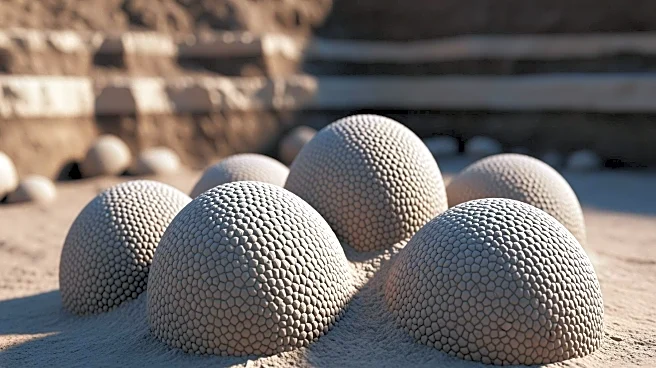
A significant paleontological discovery has been made in the Bauru Group of Brazil, where a clutch of 47 fossilized crocodyliform eggs has been unearthed. This discovery, led by Dr. Giovanna M. X. Paixão and published in the Journal of Vertebrate Paleontology,
provides unprecedented insights into the reproductive strategies of Mesozoic crocodyliforms, which are ancient relatives of modern crocodiles. The eggs, found in the Upper Cretaceous units, were preserved in remarkable condition, allowing researchers to study their features in detail. The clutch, referred to as MPM 447, is notable not only for its size but also for its implications regarding the nesting behaviors and ecological adaptations of these ancient reptiles. The eggs' high porosity and thickness suggest they were laid in a humid environment, indicating that the species may have thrived in semi-aquatic conditions.
Why It's Important?
This discovery is crucial for understanding the evolutionary strategies and behaviors of crocodyliforms during the Mesozoic era. The size and preservation of the egg clutch provide valuable data on the reproductive strategies of these ancient creatures, including potential communal nesting behaviors. The findings suggest that crocodyliforms may have engaged in complex social interactions, similar to modern crocodiles. This research enhances our understanding of the ecological dynamics of the Mesozoic period, offering insights into how these reptiles adapted to their environments. The study also contributes to broader paleontological knowledge by providing a clearer picture of the biodiversity and ecological interactions within the Bauru Group, a site known for its diverse fossil record.
What's Next?
Dr. Paixão and her team are continuing their research on other fossil clutches from the same locality, including those attributed to theropod dinosaurs and birds. These ongoing studies aim to further explore the reproductive behaviors and ecological interactions of various prehistoric species within the Bauru Group. Future research may reveal more about the potential parental care behaviors of crocodyliforms, as well as the broader ecological context of the site. The results of these investigations could significantly advance our understanding of the social and reproductive strategies of ancient reptiles, providing a more comprehensive view of the Mesozoic ecosystem.