







What's Happening?
FirstEnergy's Illuminating Company is responsible for trimming trees that interfere with power lines in Lakewood, Ohio. This service is distinct from the general tree maintenance performed by private companies or the city's public tree program. When tree limbs
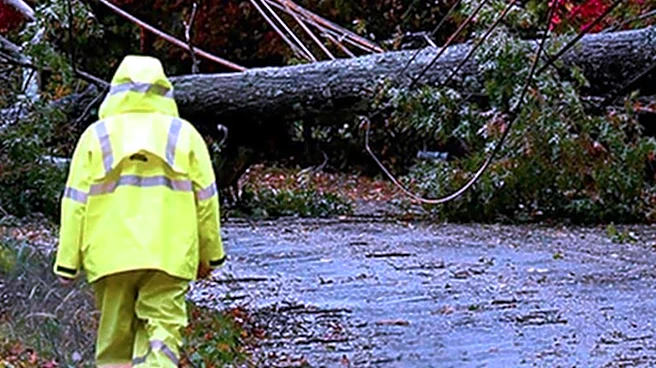
are in contact with power lines, residents are advised to report these issues directly to FirstEnergy or Cleveland Public Power, depending on which utility serves their street. Private tree service companies, such as A300 Cuts, explicitly state that they do not cut branches that are in contact with energized lines due to safety concerns. The utility's tree trimming efforts are primarily focused on maintaining clear lines for power delivery, often involving directional cuts away from wires, rather than shaping the entire tree for aesthetic purposes. Residents can utilize an online form provided by FirstEnergy to report tree problems near their power lines.
Why It's Important?
The clear delineation of responsibility for tree trimming near power lines is crucial for public safety and reliable electricity supply in Lakewood, Ohio. Untrimmed trees near power lines pose significant risks, including power outages, electrical fires, and potential electrocution hazards. By having FirstEnergy handle these specific trimming tasks, the community benefits from specialized expertise and equipment necessary to safely manage vegetation around high-voltage infrastructure. This also prevents private citizens or unqualified tree services from attempting dangerous work. For homeowners, understanding this distinction is vital to ensure that hazardous situations are addressed by the appropriate authority, preventing accidental damage to property or injury. The utility's focus on line clearance, while not comprehensive tree care, is a critical component of maintaining essential services and community safety.
What's Next?
Residents encountering tree limbs near power lines in Lakewood, Ohio, should continue to report these issues directly to FirstEnergy's Illuminating Company or Cleveland Public Power. The utilities will then dispatch their crews to address the vegetation that poses a risk to power infrastructure. It is expected that FirstEnergy will maintain its schedule of tree trimming to ensure ongoing power line clearance, which may involve periodic work in various neighborhoods. Homeowners with general tree maintenance needs on their property, not directly involving power lines, will continue to rely on private tree service companies or the city's urban forestry program for trees on public land. Public awareness campaigns or information dissemination from the utilities could further clarify these responsibilities, ensuring residents know the correct procedure for reporting and resolving tree-related power line issues.
Beyond the Headlines
The division of labor in tree maintenance between private property owners, municipal urban forestry programs, and utility companies like FirstEnergy highlights a complex interplay of public safety, infrastructure maintenance, and environmental stewardship. While utilities prioritize power delivery, their trimming practices can sometimes conflict with aesthetic preferences or broader ecological goals for urban tree canopies. This situation underscores the need for coordinated efforts and clear communication among all stakeholders to balance the necessity of reliable power with the desire for healthy, well-maintained urban forests. Long-term implications could include discussions on integrated vegetation management strategies that consider both utility needs and community greening initiatives, potentially leading to more holistic approaches to urban tree care that benefit both infrastructure resilience and environmental quality.