






What's Happening?
A new study by astrophysicist Amirnezam Amiri from the University of Arkansas proposes that some of the coldest objects in the Milky Way, previously classified as stars, could be giant energy-harvesting structures built by advanced alien civilizations.
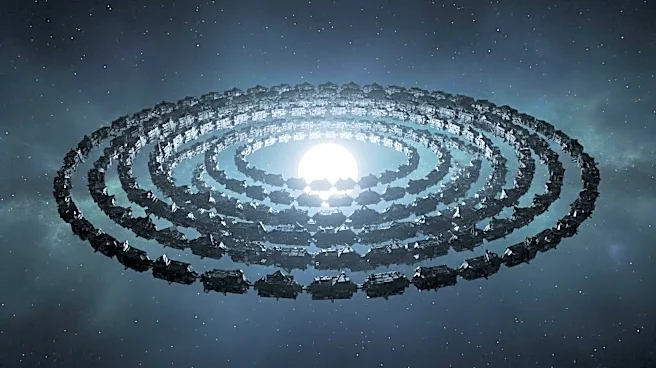
These structures, known as Dyson swarms, would collect a star's energy and emit leftover heat as infrared radiation. The study, set to be published in the journal Universe, introduces a mathematical method to identify these potential alien structures. The concept of a Dyson swarm, first proposed by physicist Freeman Dyson, involves millions of solar collectors orbiting a star, rather than a single shell. Red and white dwarfs are considered ideal candidates for such systems due to their longevity and smaller size, which require less material for construction.
Why It's Important?
The possibility of discovering alien megastructures has profound implications for our understanding of the universe and the existence of advanced civilizations. Identifying Dyson swarms could provide evidence of extraterrestrial life and technological advancement beyond Earth. This research also challenges current astronomical classifications and encourages the development of new methods to detect and study such phenomena. The study's findings could lead to a paradigm shift in how scientists search for signs of alien technology and understand the potential for life in the universe.
What's Next?
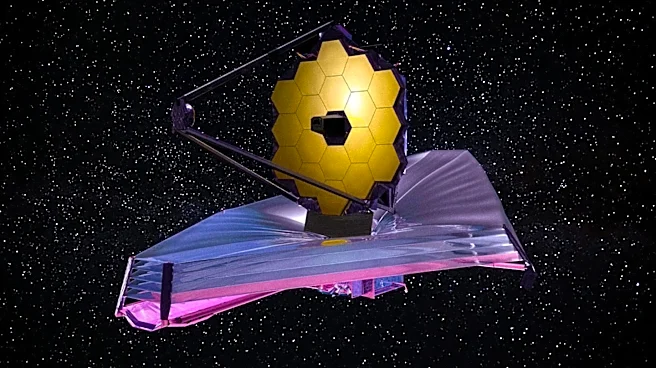
Astronomers are actively searching for signs of Dyson swarms using tools like the James Webb Space Telescope and projects such as Project Hephaistos. These efforts aim to identify unusual infrared signatures that could indicate the presence of alien megastructures. As observational techniques improve, scientists hope to confirm the existence of these structures and gain insights into their construction and purpose. Continued research will focus on distinguishing Dyson swarms from natural phenomena and understanding their implications for the search for extraterrestrial life.