
What's Happening?
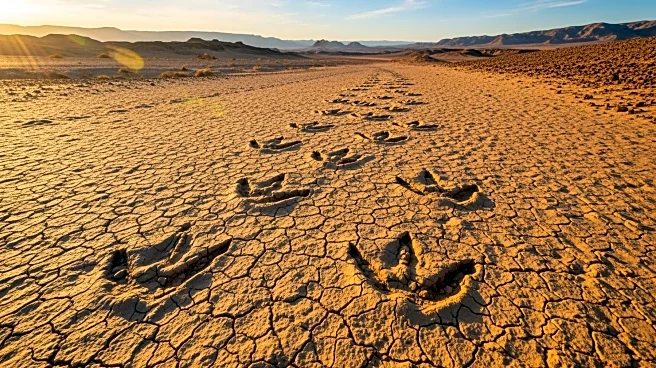
In a groundbreaking discovery, scientists have identified the largest known dinosaur track site in the world at Carreras Pampa, Torotoro National Park, Bolivia. The site, dating back to the late Cretaceous
Period approximately 70 million years ago, contains over 16,600 footprints and swim traces. These tracks were primarily made by theropods, which are bipedal three-toed dinosaurs, and also include bird tracks. The tracks are aligned in the same direction, suggesting movement parallel to an ancient shoreline. This discovery, documented in a PLOS One paper, includes 1,321 trackways and 289 isolated tracks, along with 280 swim trackways and multiple tail traces. The site preserves at least a dozen distinct track morphologies, indicating the presence of multiple animal types. However, identifying specific species is challenging due to the variability in footprint shapes and the absence of fossil bones at the site.
Why It's Important?
This discovery is significant as it provides a rare glimpse into the behavior and ecology of ancient dinosaurs. The alignment of tracks suggests possible social behavior, such as group movement or migration, and offers clues about predator-prey interactions along ancient shorelines. The site serves as an archive of an ancient ecosystem, capturing a snapshot of the biodiversity and interactions of that era. This can enhance our understanding of dinosaur behavior, their environment, and how they might have adapted to their surroundings. Such insights are crucial for paleontologists and evolutionary biologists studying the dynamics of prehistoric life and the factors that influenced the evolution and extinction of species.
What's Next?
Further analysis of the site is expected to yield more detailed insights into the daily lives of these ancient creatures. Researchers may conduct additional studies to better understand the specific behaviors and interactions of the species that left these tracks. This could involve comparing the Bolivian site with other track sites globally to identify patterns or anomalies in dinosaur behavior. The findings could also inform models of ancient ecosystems, contributing to broader research on climate and environmental changes over geological timescales.
Beyond the Headlines
The discovery raises intriguing questions about the preservation of such extensive track sites and the conditions that allowed for their formation. It also highlights the potential for similar undiscovered sites around the world, which could further illuminate the history of life on Earth. The study of these tracks not only enriches our understanding of dinosaurs but also underscores the importance of preserving natural heritage sites that hold keys to our planet's past.