



What's Happening?
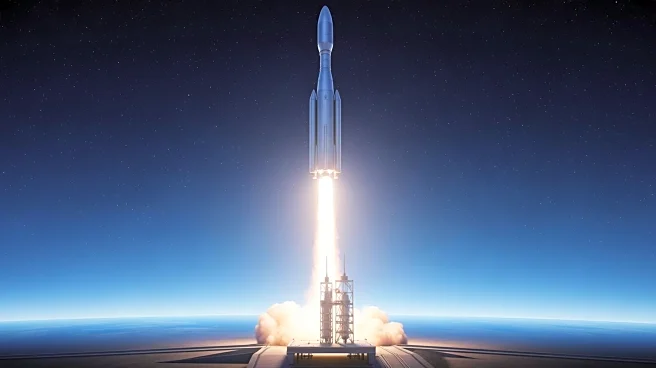
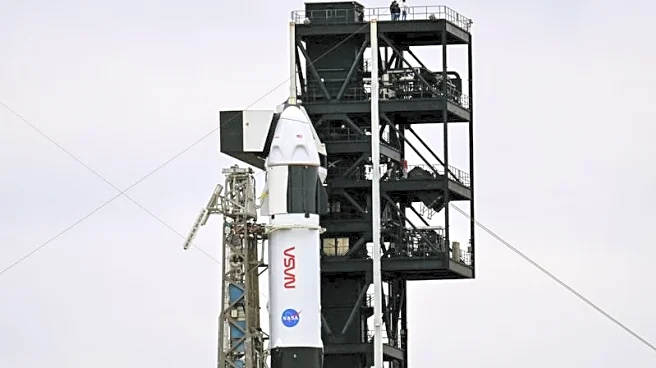
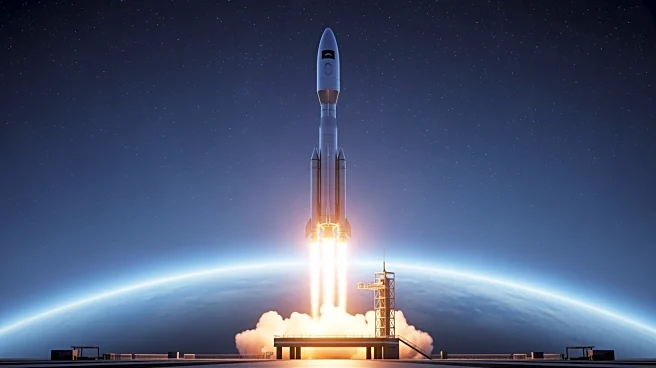
NASA's SpaceX Crew-12 mission successfully launched from Cape Canaveral Space Force Station in Florida on February 13, 2026. The mission, part of NASA's Commercial Crew Program, utilized a SpaceX Falcon 9 rocket carrying the Dragon spacecraft. Onboard
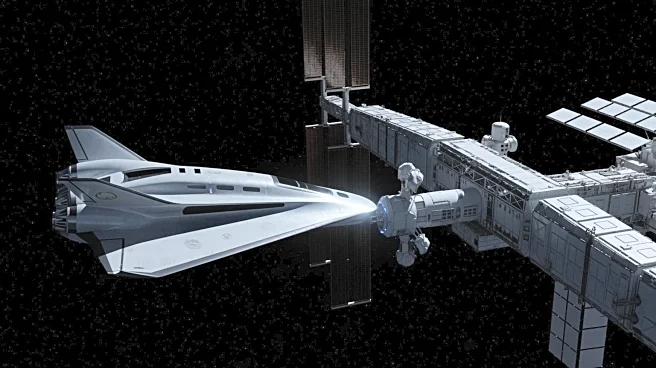
were NASA astronauts Jessica Meir and Jack Hathaway, ESA astronaut Sophie Adenot, and Roscosmos cosmonaut Andrey Fedyaev. The crew lifted off at 5:15 a.m. EST from Space Launch Complex 40. This mission marks the twelfth crew rotation of the SpaceX Dragon spacecraft and Falcon 9 rocket to the International Space Station (ISS). Upon arrival, the crew will engage in various scientific experiments and technology demonstrations aimed at benefiting life on Earth and advancing space exploration goals, including missions to the Moon and Mars.
Why It's Important?
The successful launch of NASA's SpaceX Crew-12 mission underscores the ongoing collaboration between NASA and private space companies like SpaceX, which is crucial for the future of space exploration. This mission not only supports the continuous human presence on the ISS but also contributes to scientific research that can have significant impacts on Earth. The experiments conducted by the crew are expected to advance knowledge in fields such as biology, physics, and materials science, potentially leading to technological innovations and improvements in various industries. Additionally, the mission is a step forward in NASA's long-term goals of returning humans to the Moon and eventually reaching Mars, highlighting the importance of international cooperation in space exploration.
What's Next?
Following their arrival at the International Space Station, the Crew-12 astronauts will begin their scheduled experiments and technology demonstrations. These activities are designed to enhance our understanding of living and working in space, which is essential for future deep-space missions. The crew's work will also support NASA's Artemis program, which aims to return humans to the Moon. As the mission progresses, NASA and its international partners will continue to monitor and support the crew's activities, ensuring the success of their objectives. The data and insights gained from this mission will inform future crewed missions and contribute to the development of technologies necessary for long-duration space travel.