




What's Happening?
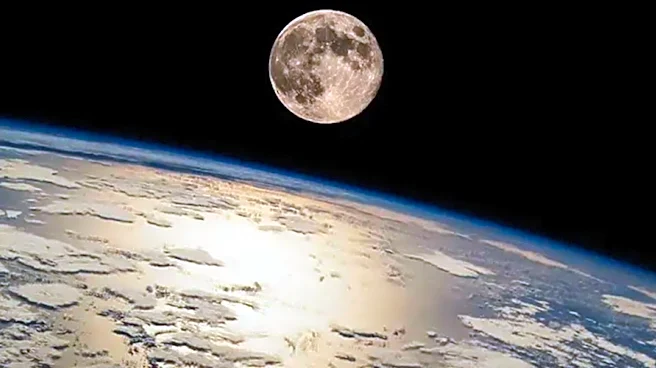
NASA's ESCAPADE mission has released new images of Earth and the Moon, captured by one of its twin spacecraft on July 3. The images, taken in visible and infrared wavelengths, show the crescent Earth and Moon from a unique vantage point. The spacecraft are currently
in a 'loiter' orbit around Lagrange point L2 and are set to fly by Earth in November to slingshot towards Mars, where they will arrive in September 2027. The mission aims to study the interaction between solar wind and the Martian environment, focusing on atmospheric loss at the Red Planet.
Why It's Important?
The ESCAPADE mission is crucial for understanding how solar wind affects Mars' atmosphere, which has implications for future exploration and potential colonization. By studying atmospheric loss, scientists can better predict climate conditions on Mars, aiding in the development of sustainable living conditions for future missions. The images also provide valuable data for understanding celestial mechanics and the dynamics of planetary bodies, contributing to broader scientific knowledge.
What's Next?
The ESCAPADE spacecraft will continue their journey towards Mars, with a planned flyby of Earth in November to gain the necessary velocity for their Martian arrival. Upon reaching Mars, the mission will conduct detailed studies of the planet's atmosphere and its interaction with solar wind, providing insights that could influence future Mars missions and exploration strategies.