




What's Happening?
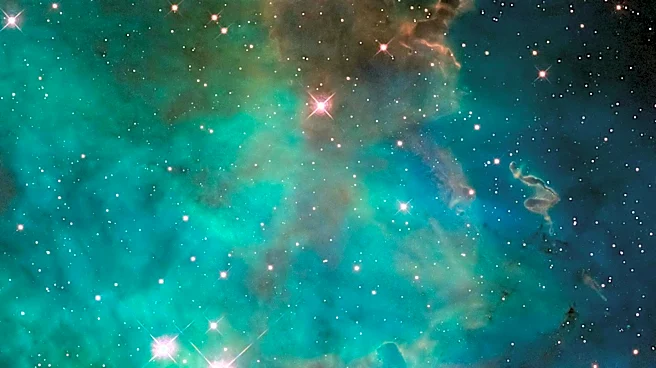
The James Webb Space Telescope (JWST) has identified a new dwarf planet candidate in the IC 348 star-forming region, approximately 1,000 light-years away in Perseus. This object, with an estimated mass of only about twice that of Jupiter, is considered
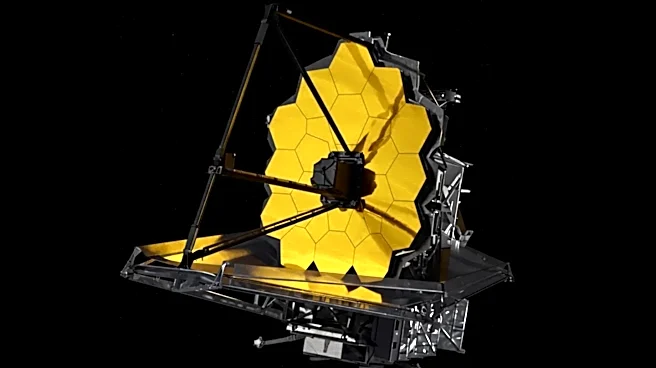
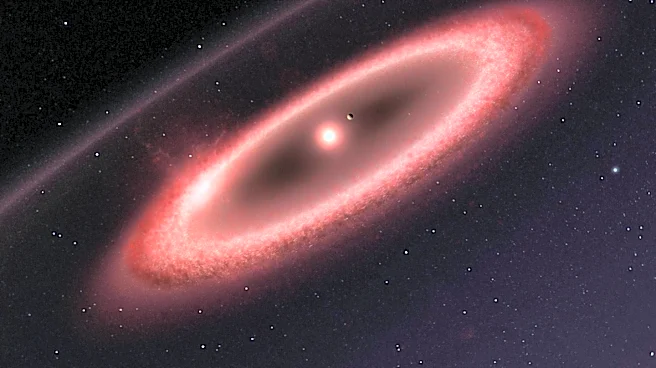
the least massive free-floating brown dwarf with spectral evidence. The discovery, published in The Astrophysical Journal Letters, pushes the observational boundary of star formation into a mass range typically associated with giant planets. The JWST's Near-Infrared Camera (NIRCam) and Near-Infrared Spectrograph (NIRSpec) were instrumental in identifying 19 additional candidates and confirming nine new brown dwarfs, including the two-Jupiter-mass object. One of these newly identified objects also shows evidence of a circumstellar disk, suggesting the presence of planet-forming material around a body already comparable in mass to a large planet. Furthermore, the research team detected an unexplained absorption band at 3.4 micrometers in eight of the nine new members, attributed to an aliphatic hydrocarbon, leading to a proposal for a new 'H' spectral class for these exceptionally cool newborn brown dwarfs.
Why It's Important?
This discovery significantly challenges existing star-formation models by demonstrating that collapsing molecular clouds can produce objects with masses comparable to giant planets. Traditionally, planets are expected to form within disks around stars, while brown dwarfs form directly from collapsing clouds. The existence of a free-floating object with a planetary mass that appears to have formed like a star blurs the conventional distinction between planets and brown dwarfs, which has historically relied on mass, nuclear physics, orbital status, and formation history. The finding suggests that the lower limit of star-like formation is much smaller than previously thought, prompting astronomers to re-evaluate the processes governing the formation of substellar objects. The presence of a circumstellar disk around such a low-mass object also raises the intriguing possibility of planet formation around a body that itself is only twice Jupiter's mass, further complicating the definitions of planetary systems and their origins. This research provides a crucial laboratory for testing the boundaries of star formation and refining the initial mass function, which describes the frequency of stars and brown dwarfs of different masses.
What's Next?
Astronomers will continue to analyze the data from the James Webb Space Telescope, as even smaller candidates, potentially approaching Jupiter's mass, may still be present in the observations. Further spectroscopic confirmation will be necessary to determine if these fainter objects truly belong to the IC 348 cluster. The proposed 'H' spectral class for hydrocarbon-rich brown dwarfs will require more examples and detailed studies to establish subclasses and identify the exact molecules responsible for the observed absorption feature. Future observations, particularly at longer wavelengths, are needed to fully characterize the circumstellar disk around the two-Jupiter-mass object and assess its potential for forming companions. The ongoing research will focus on refining evolutionary models for young brown dwarfs in this new mass regime, as current models lack direct tests from dynamical masses. The scientific community will also explore the implications of these findings for the broader understanding of planetary system formation and the definition of celestial bodies.
Beyond the Headlines
The blurring of the lines between planets and stars, as highlighted by this discovery, has profound implications for how humanity categorizes and understands the cosmos. It challenges the rigid classifications that have long guided astronomical research, suggesting that the universe's processes are more fluid and interconnected than previously assumed. This finding could lead to a re-evaluation of what constitutes a 'planet' or a 'star,' moving beyond simple mass thresholds to incorporate formation mechanisms and environmental context. Ethically, it underscores the dynamic nature of scientific knowledge and the continuous need for observation and theoretical refinement. Culturally, it expands the human imagination regarding the diversity of celestial objects and the potential for unexpected forms of planetary systems. The unexplained hydrocarbon signature also opens a new avenue for astrochemical research, potentially revealing unique atmospheric compositions and processes in these extreme environments, which could have implications for understanding the building blocks of life in diverse cosmic settings.