





What's Happening?
The USS John F. Kennedy (CVN 79), the U.S. Navy’s second Gerald R. Ford-class nuclear-powered aircraft carrier, has successfully completed its acceptance sea trials. This significant milestone, announced by Huntington Ingalls Industries (HII) on August
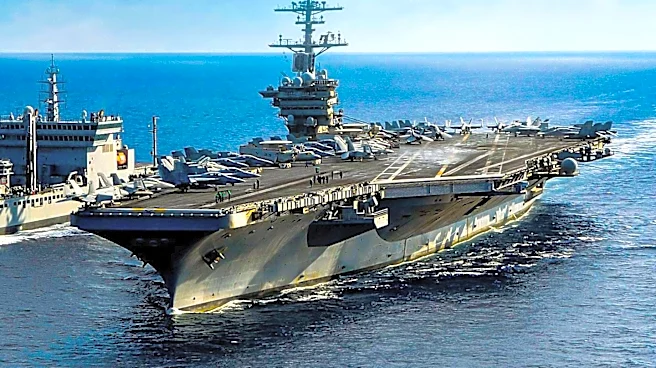
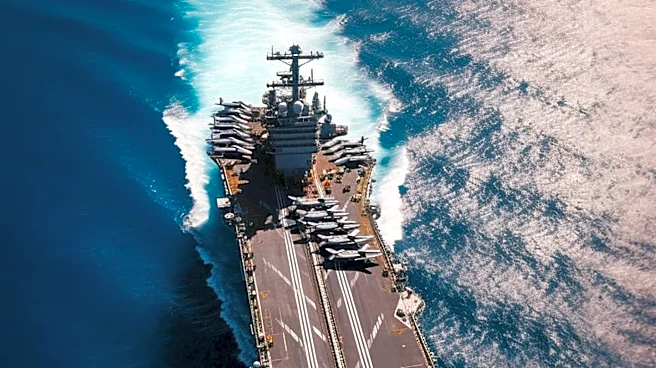
15, involved three days of rigorous testing at sea to evaluate the carrier's key systems and overall operations. The vessel, which departed Newport News on August 12 and returned on August 15, underwent assessments of its propulsion, navigation, combat systems, and aviation infrastructure. Shipbuilders from Newport News Shipbuilding collaborated with sailors assigned to the John F. Kennedy and other Navy personnel during these trials. The successful completion of these tests allows the carrier to proceed towards preliminary acceptance, enabling the U.S. Navy to commence further specialized system testing. The John F. Kennedy, christened in December 2019, is one of the largest warships ever constructed, measuring 1,106 feet in length and powered by two nuclear reactors. It incorporates advanced technologies such as the Enterprise Air Surveillance Radar, upgraded weapons elevators, the Electromagnetic Aircraft Launch System (EMALS), and an electromagnetic arresting system, differing from older Nimitz-class carriers. The total program cost exceeds $13 billion.
Why It's Important?
The completion of acceptance sea trials for the USS John F. Kennedy marks a crucial step in strengthening the U.S. Navy's fleet capabilities and national defense. As the second carrier in the Gerald R. Ford class, its integration will enhance the Navy's capacity for global power projection and maritime security. The vessel's advanced technologies, including EMALS and electromagnetic arresting systems, are designed to significantly improve operational efficiency, increase the number of daily flight operations, and reduce crew requirements compared to previous carrier classes. This modernization is vital for maintaining the U.S. military's technological edge and ensuring its ability to respond to evolving geopolitical challenges. The successful trials also validate the substantial investment in the Ford-class program, which aims to replace the aging Nimitz-class fleet with up to ten new carriers. The ability of the John F. Kennedy to operate F-35C Lightning II fighter jets upon delivery, under the single-phase delivery approach, streamlines its deployment readiness and reduces the need for post-delivery modifications, thereby impacting long-term operational costs and timelines for the Navy.
What's Next?
Following the successful acceptance sea trials, the USS John F. Kennedy will move towards preliminary acceptance by the U.S. Navy. This phase will allow the Navy to conduct additional testing of systems unique to the ship. The carrier is currently expected to be delivered in March 2027. Until its formal acceptance and commissioning, the vessel will remain a pre-commissioning unit. Newport News Shipbuilding anticipates that the carrier will support a higher number of flight operations with fewer crew members and is built to accommodate future technologies, including laser weapons. The Navy's ongoing evaluation of Ford-class carrier designs, particularly regarding the placement of the command tower and the use of EMALS, as directed by the White House, could potentially influence future carriers in the class, such as the USS Doris Miller. However, any significant design changes to the John F. Kennedy itself are unlikely at this stage, given its advanced state of construction and successful trials. The focus will now shift to integrating the carrier into the fleet and ensuring its full operational readiness.
Beyond the Headlines
The successful trials of the USS John F. Kennedy underscore a broader strategic shift in naval warfare, emphasizing technological superiority and operational efficiency. The adoption of advanced systems like EMALS and electromagnetic arresting gear represents a departure from traditional steam-powered mechanisms, reflecting a commitment to innovation despite initial development challenges and cost overruns. This technological evolution has implications for the defense industrial base, driving demand for specialized engineering and manufacturing capabilities. Furthermore, the design philosophy of requiring fewer crew members for increased operational capacity highlights a trend towards optimizing human resources in complex military assets, potentially influencing recruitment, training, and personnel management strategies within the Navy. The long-term impact of these advanced carriers extends beyond military readiness, influencing international power dynamics and the U.S.'s role in global security. The substantial investment and technological advancements in the Ford-class program also reflect a national commitment to maintaining a dominant naval presence, which can have ripple effects on allied defense strategies and global trade routes.