
What's Happening?
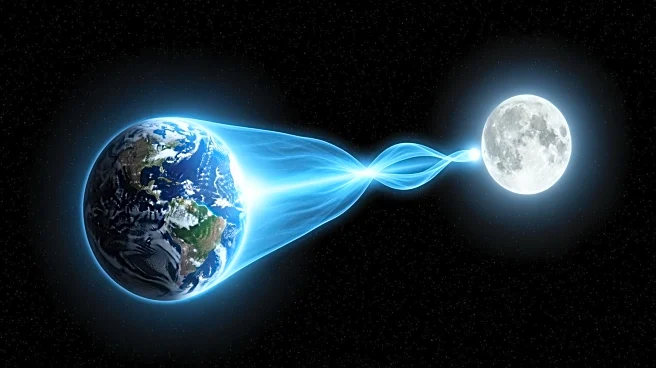
A recent study conducted by astrophysicists at the University of Rochester has uncovered that Earth's atmosphere has been leaking to the Moon for billions of years. This phenomenon is facilitated by Earth's magnetic
field, which channels atmospheric particles onto the lunar surface. The study, published in Nature Communications Earth & Environment, challenges previous assumptions that Earth's atmosphere could only have contributed to the Moon's surface before the development of the planet's magnetic field. The research team simulated two scenarios: one with an early Earth model lacking a magnetic field and another with a modern Earth model featuring a strong magnetic field. The findings indicated that the modern Earth scenario, with its strong magnetic field, better explained the presence of volatile elements, such as nitrogen, in the lunar regolith. This discovery suggests that Earth's atmosphere has been a significant source of these elements, alongside solar wind and meteorite impacts.
Why It's Important?
The study's findings have significant implications for our understanding of the Moon's composition and the history of Earth's atmosphere. The presence of volatile elements in the lunar regolith, which have accumulated over billions of years, could serve as a time capsule, preserving historical data about Earth's atmospheric changes. This research not only enhances our knowledge of lunar geology but also provides insights into the interactions between Earth and its satellite. The discovery could influence future lunar exploration missions, as understanding the Moon's surface composition is crucial for potential resource utilization and habitation. Additionally, the study highlights the dynamic nature of Earth's magnetosphere and its role in shaping the lunar environment.
What's Next?
Future research may focus on further analyzing the volatile elements found in the lunar regolith to extract more detailed information about Earth's atmospheric history. This could involve more sophisticated simulations and potentially new lunar missions to collect additional samples. The findings may also prompt a reevaluation of the Moon's potential as a resource for future space exploration, particularly in terms of water and other volatiles that could support human activities. As scientists continue to explore the implications of this atmospheric leakage, collaborations between space agencies and research institutions may increase to deepen our understanding of the Earth-Moon system.
Beyond the Headlines
The study opens up new avenues for exploring the ethical and legal dimensions of lunar exploration. As the Moon's resources become more attractive for future missions, questions about ownership, usage rights, and environmental preservation will likely arise. The potential for Earth's atmosphere to contribute to the Moon's surface composition also raises intriguing questions about the interconnectedness of celestial bodies and the long-term impacts of human activity in space. This research underscores the importance of developing international frameworks to manage space resources responsibly and sustainably.