
What's Happening?
NASA's Curiosity rover has identified the most diverse set of organic molecules yet discovered on Mars, as reported in a recent scientific paper. The discovery was made from a rock sample collected in 2020
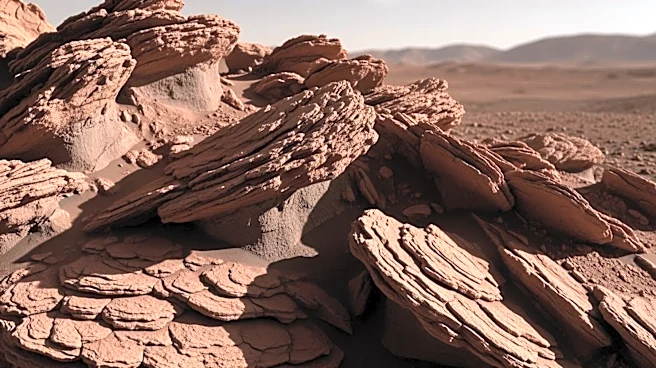
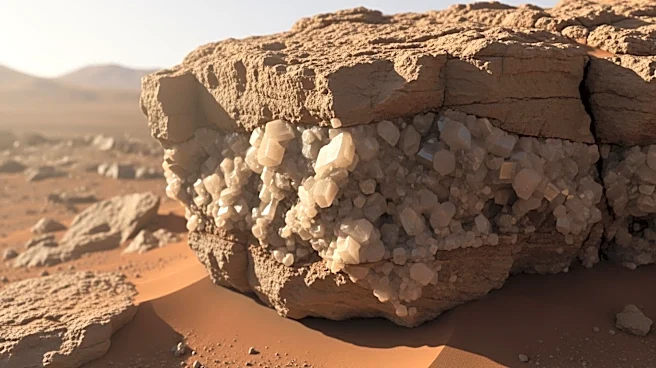
in the Mount Sharp area of Gale Crater, a region known for its historical presence of lakes and streams. The sample revealed 21 carbon-containing molecules, including seven previously undetected on Mars. These findings suggest that Mars had complex organic chemistry, although they do not confirm the presence of life. The molecules were found in clay-rich sandstones, which are significant because clay can preserve organic compounds over billions of years. The discovery highlights the potential for surface rocks on Mars to retain chemical records, offering new insights into the planet's ancient environments.
Why It's Important?
This discovery is crucial for understanding Mars's past environments, which may have been conducive to life. The presence of diverse organic molecules in ancient rocks suggests that Mars had the necessary chemical ingredients for life, even if life itself has not been confirmed. This finding supports the idea that Mars once had a thicker atmosphere and more active water processes, creating conditions that could have supported complex chemistry. The results also guide future missions in their search for signs of past life, indicating that valuable chemical evidence can be found in surface rocks, not just in deep subsurface structures. This expands the scope of astrobiological research on Mars and informs the planning of upcoming missions.
What's Next?
The discovery sets the stage for future Mars missions, such as the European Space Agency's Rosalind Franklin rover, which will search for biosignatures beneath the Martian surface. The success of the Curiosity rover's wet chemistry experiment, which used a reagent to break down complex organic structures, suggests that similar methods could be employed in future missions to analyze Martian rocks more effectively. These missions will continue to explore Mars's geological history and its potential for habitability, building on the foundation laid by Curiosity's findings.
Beyond the Headlines
The discovery of diverse organic molecules on Mars challenges previous assumptions about the planet's ability to preserve chemical records. It underscores the importance of selecting scientifically promising sites for exploration, as demonstrated by Curiosity's targeted drilling in clay-rich areas. This approach maximizes the chances of uncovering significant chemical evidence. The findings also highlight the need for careful interpretation of data, as organic molecules can form through both biological and non-biological processes. This cautious approach ensures that scientific conclusions are robust and reliable, contributing to a more comprehensive understanding of Mars's potential for life.