







What's Happening?
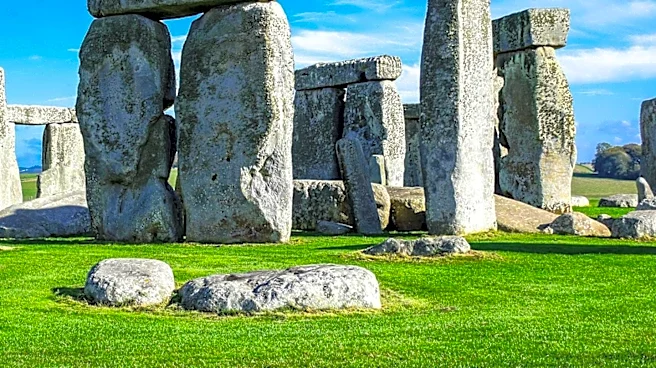
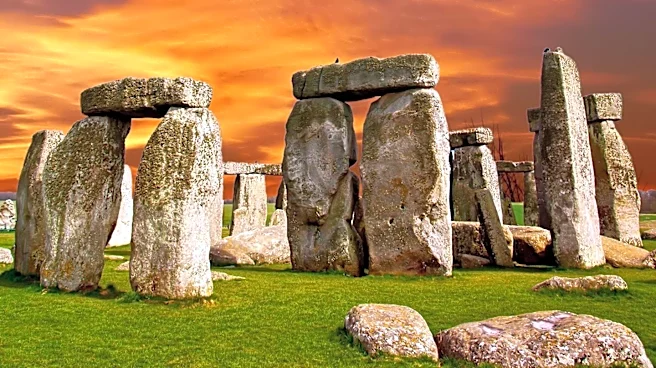
Archaeologists from Wessex Archaeology have uncovered an ancient structure near Stonehenge that may have served as an early prototype for the solstice alignment at the famous site. Located about five kilometers from Stonehenge, the site has been radiocarbon
dated to approximately 5,000 years ago, around the time of Stonehenge's earliest phase of construction. The site, believed to have been a focus for religious gatherings, shows evidence of feasting and large-scale gatherings. Researchers discovered two pits that likely held wooden poles aligned with the solstices, suggesting that ancient people celebrated the solstice here at least 500 years before Stonehenge's stones were aligned.
Why It's Important?
This discovery provides new insights into the cultural and religious practices of prehistoric communities in the Stonehenge landscape. It suggests that the alignment of structures with the solstices was a well-established tradition long before Stonehenge's construction. This finding challenges the perception of Stonehenge as a singular creation, instead highlighting its emergence from deeper traditions and practices. Understanding these early alignments can shed light on how ancient peoples understood the cosmos and their place in it, offering a glimpse into their religious and cultural beliefs.
What's Next?
Further archaeological investigations may be conducted to explore other sites in the Stonehenge landscape for similar alignments. Researchers may also study the broader implications of these findings for understanding prehistoric religious practices and their influence on later structures like Stonehenge. Public interest in the site may increase, leading to discussions about its preservation and potential for educational programs.
Beyond the Headlines
The discovery underscores the importance of astronomical alignments in prehistoric religious practices. It highlights how ancient communities used these alignments to mark the passage of time and ensure the continuity of natural cycles. This finding also raises questions about the role of religion in shaping early human societies and their interactions with the environment.